Sunday, April 13, 2008
Gone Baby Gone
Tuesday, April 8, 2008
Secret of the Grain

The Secret of the Grain has so far swept up all the major Cesar Awards, as well as France’s most coveted honour, the Prix Louis Delluc. Internationally, it has been released to widespread acclaim, and, here in Perth, it is the first film from Cinema Paradiso’s recent Alliance Français French Film Festival to have received a longer release. This may seem a strange pattern of events, given director Abdellatif Kachiche’s penchant for divisively subversive cinema techniques. In this film, plot is rendered secondary to the dynamics of character interaction, and everyday exchanges are allowed to unfold at great (and sometimes unnecessary) length. Character focus shifts erratically throughout the film, pacing is distinctively uneven, and, throughout the film’s two and a half hour duration, there is ample opportunity to question its purpose and its point.
In short, the film is a lot of work, and what you get out of it is not the traditional cinematic experience of climax and resolution. Instead, Kachiche paints a vivid picture of an often-overlooked part of France. He introduces us to Silimane, a sixty-year-old North African immigrant, and his loving but unconventional family – a devoted ex-wife, their four children, grandchildren and children-in-law, plus his current lover and her sparkling teenage daughter, Rym. He presents Silimane’s daily struggles with immigrant life and with family without warping them into a falsified narrative structure, instead allowing them to unfold more naturally and haphazardly. This overwhelming realism can be tiring and tedious, but it can also rewarding. The actors are able to bring a raw sincerity to their characters, and emotions are allowed to play out without restraint (in a manner that is at times quite confronting). Still, it’s certainly not a film that everyone will enjoy, and the urge to whip out some scissors and give it a more thorough editing is at times quite overwhelming. Approach this one with caution, and make sure you’re in the right state of mind before you purchase your ticket.
Monday, March 24, 2008
In the 1950s, a series of movies about a school of mischievous young girls were released in Britain. Today, writer Piers Ashworth has continued the concept with St Trinian’s; a modern take on the traditional concept and a veritable who’s who of (mainly) English stars and household names. Colin Firth is once more doused in water as he self-consciously mocks his ‘Jane Austen heartthrob’ reputation (why does he do this?), Stephen Fry appears as children’s game show ‘quizmaster’ who enjoys his job just a little too much, model Lilly Cole dons glasses and plays a dorky teenager, comedian Russell Brand is a dodgy character from the town’s crime-ridden underground and even The OC’s Misha Barton shows up in a completely unnecessary cameo appearance. And yet, in amongst all these icons, there can be no doubt as to who is the star of the show. That would, of course, be Rupert Everett.The makers of this film have obviously opted to follow the path set out before them by Hairspray, and have stayed true to the film’s original concept by casting a man to play the school’s eccentric headmistress (even though they have altered so much else). And, though it’s easy to be sceptical about this decision, it has to be said that Everett rises to this occasion magnificently. Whether he’s carefully adding strokes to a still life painting, waltzing down the stairs inexplicably dressed in an Elizabethan gown, or painfully flirting with an ex-lover (played by Firth), Everett’s complete completely exaggerated (yet always so serious) performance is genuinely hilarious. The rest of the story, and the rest of the stars, pale in comparison. I vaguely remember something about the school getting shut down, and the girls organising a full scale heist in the hope of scoring enough money to keep the institution going. No doubt 13-year-old girls will be more appreciative of this storyline, with its irreverent glorification of mischief and, of course, the obligatory make-over scene. Certainly, don’t go out of your way to see St Trinian’s, but, if you’re forced to, don’t panic. There are worse films out there.
Sunday, March 16, 2008
Be Kind Rewind, Before the Devil Knows You're Dead

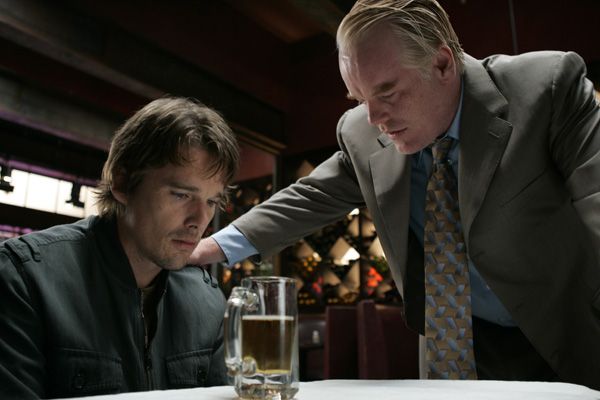
Before the Devil Knows You’re Dead is jigsaw of narrative strands, jumbled and waiting for you to fit them together. It opens with a scene of happiness, followed quickly by a robbery-gone-terribly-wrong, and from there it jumps haphazardly through a series of different perspectives from different points before, during and after the robbery, gradually adding more layers to the story. Ethan Hawke opens proceedings as Hank, a spineless, cowardly character motivated by a need to appease his demanding ex-wife and thus maintain some sort of relationship with his daughter. Phillip Seymour Hoffman then takes over as Andy, Hank’s far more successful and more self-assured older brother, who has a nice office and a sexy wife (Marisa Tomei), but also a nasty habit and a toxic desire for change. It’s of course Andy who draws the ingratiating Hank into an unthinkable crime.
As much a crime melodrama as it is a suspense thriller, Before the Devil Knows You’re Dead will feel a bit much at some points, but the talented cast deliver their lines with such grandeur that it all begins to feel quite appropriate. There’s an almost Shakespearean quality to the film, particularly as tensions escalate towards its dramatic conclusion. In amongst all the fine acting, Hoffman in particular is brilliant as always, casting complexity across his character so you’re left battling feelings of disgust against feelings of sympathy. All these performances, plus some very clever screenwriting, will add up to attract and hold your emotional and intellectual involvement. These are characters that we genuinely care about, so the crime’s emotionally-wrought aftermath is as (if not more) interesting than its suspenseful prelude. If you’re up for some heavy, but totally engaging, drama, 83-year-old writer/director Sidney Lumet has definitely delivered with this one.
Wednesday, February 6, 2008
Eden
And much as the film can’t settle on a single tone, this reviewer similarly can’t settle on a decisive opinion. While it would be easy to dismiss Eden for its inconsistency, there’s a certain quality to the film that can’t be ignored. In remaining solely on the surface of this relationship, writer/director Michael Hofmann teases and intrigues his audience. In briefly delving into symbolic allusions, he charms his viewers with the promise of something beneath the surface, even if it that ‘something’ is just beyond our reach. So, while Eden may be frustrating, and while it may lack the kind of visually clear cues that we’ve come to expect from food-focused narratives like Chocolat (I’m talking about those slow, seductive images of the most delicious food imaginable – with no bloody carcasses in sight), there’s a beauty to be found in that absence. It’s much like watching a cooking show – you’ll see all the ingredients in front of you, but it will be up to you to decide whether or not that’s as satisfying as actually eating a meal. And it’s also worth noting that at least there’s a side dish of endearing performances and interesting dialogue to make it all just a little easier.
Monday, January 28, 2008
Joy Division; Prague
This week, amongst a flurry of tunes, pizza and beer, Luna Outdoor will premier the documentary Joy Division. Riding fresh on the coat tails of Control’s recent success, one can confidently expect a large turn out for this, more rigorous, exploration of the Manchester band’s inspiring start and tumultuous decline – though the two could hardly be considered mutually exclusive. For starters, Joy Division’s director Grant Gee (who has previously worked on documentaries about Radiohead, Gorillaz and Scott Walker) has chosen to look more broadly at the context of the events. Through never-before-seen footage, audiotapes, personal photos and period films, Gee creates a collage that represents not only the band, but also their city and the musical/artistic movement that they belonged to. As the late Tony Wilson states in a voice-over that opens the film, the story of Joy Division is also the story of Manchester, and of a city awakened by their music. Indeed, it’s hard to watch the documentary without feeling drawn into the infectious punk atmosphere of 1980s Manchester, alive with new hope and music.
Strikingly intimate interviews with the surviving members of Joy Division, fellow musicians and musical icons, and even with Anton Corbijn (the director of Control) are slotted into the footage, adding detail and cohesion to the period collage. While many Joy Division ‘anecdotes’ (such as their famous meeting at Manchester Hall, their involvement with Tony Wilson and so on) have been milked dry by the double impact of Control and 24 Hour Party People, it is surprising to learn that these interview subjects still have something fresh to offer. Gee has directed them to speak with great sincerity and insightfulness – one notable example being the way in which the band members and Annike Honore (the Belgian journalist with whom Curtis had an affair) reflect upon how everyone seemed to ignore the darkness of Curtis’s lyrics. Similarly, it’s touching to see the Joy Division story carried beyond Curtis’s death, to look at the musical and cultural legacy that the band left behind them before going on to become New Order.
Rating: 7.1

Every film festival has to reach its nadir, and for PIAF’s Lotterywest Film Festival, it seems that point is Prague, which screens at Sommerville from next week. The latest film from Danish director Ole Christian Madsen (Kira’s Reason – A Love Story, Angels in Fast Motion) is a dark look at both the practical and emotional aspects of grieving, and how the two intermingle. Christoffer (Mads Mikkelson – After the Wedding, Casino Royal) and Maja (Stine Stengade – Kira’s Reason) are a couple of 14 years, whose marriage is tested when they travel to Prague to retrieve the body of Chrostoffer’s dead father. Having not seen his father since he was abandoned by him 25 years ago, Christoffer appears unfazed by the death, but is forced to leave his emotional plateau after Maja confesses to having an affair. Now trapped together in a city they both seem to despise, the couple share their final days amongst increasing levels of tension, while Christoffer simultaneously deals with his father’s lawyer, house-keeper and some ‘unexpected’ revelations.
Unfortunately, the surprises that send Christoffer over the edge are all too easy to spot from a mile away, while the extreme close-ups of a hand held camera (here an ear, there an eye) suggest a level of pretension at odds with the utterly predictable nature of the script. Madsen obviously thought he was creating something deeply moving, but whether it is the trite nature of his dialogue, or some less-than-perfect performances, at least two of the film’s central revelations were enough to send a ripple of groans/giggles through the crowd. While several scenes are genuinely emotional and thoroughly well-acted (particularly where Mikkelson is concerned), they fall flat when viewed in the context of the whole film. In the end, Prague makes a mockery of the deep themes it is presenting, and the emotional story that it is attempting to share.
Tuesday, January 22, 2008
Jane Austen Bookclub; Empties

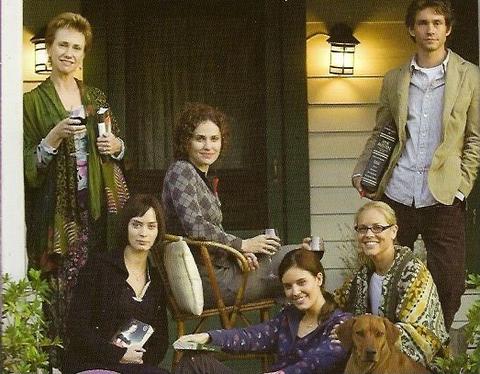
After introducing the six central characters, their various predicaments and their relationships to one another (all of which is done in the first ten minutes), there is near to no further character or plot development. The club members simply read one Jane Austen classic after another (with the progression marked in titles so we are reminded of exactly how much is left), and we watch them uncover parallels with Austen’s heroes. Sometimes this is done in a grossly obvious manner (e.g.: “Our world really is but a small English village”), while at other times the connections are barely tenuous and near impossible to spot. The ensemble cast’s acting is consistently unconvincing, though that’s to be expected with dialogue so trite that it often sounds as if it were lifted straight from the pages of the novel, with no concessions made for the switch in medium. In the end, this film does little more than suggest that Austen’s novels must all be banal and boring works, if these are the kind of lives that they reflect. The author must be rolling in her grave.
Unlike in most of Sverák's other films (and indeed in a lot of the more financially reputable comedies to have emerged from Central Europe), this protagonist provides little room for the kind of sympathy required to render the film "touching" or "sweet" or any of the other adjectives required to help a foreign film survive at the international box office. While he may suffer at the hands of his students, Josef is also grumpy, manipulative, selfish and cruel (especially to his wife), and his nightly mental excursions into a train-set sexual fantasy world do little to help the cause. It's certainly difficult to watch Empties without feeling disgrace or disdain towards Josef, and at times this enough to warp the film’s appeal. Simultaneously though, this flawed character is quite compelling viewing, and his relationships with others pose interesting questions about chemistry, love and growing old with another person beside you. In the end, there are some touching moments for those who persist, but for most these will not compensate for the effort involved.