Showing posts with label French cinema. Show all posts

Monday, January 19, 2009

The Class

It would be quite easy to mistake the recent Palme D’Or winning drama, The Class, for a documentary. Its story of classroom challenges comes straight from a teacher who has experienced this all first hand, the performances of teachers and students alike are pitch-perfect, genuine and rich, and the ‘fly-on-the-wall’ style of filmmaking (recalling something of Mike Leigh or even last year’s French hit The Secret of the Grain) is perfectly appropriate for capturing the tedium of modern teaching. Essentially, the film simply charts one teacher’s futile attempts to reach a class of mixed-race 14 year-olds in inner-city Paris. Beyond that, however, it offers a commentary on the universal challenges involved in education everywhere, particularly in this era of globalisation.

Francois Begaudeau, the teacher who wrote the book on which this film is based, plays Mr Marin. His sincere attempts to educate this class (and to reach the smarter students amongst the group) are continuously thwarted, mainly by student ‘insolence,’ and those many, mind-numbing, endlessly cyclical conversations that consume classroom time and teacher attention. For the most part, the film is simply a document of these struggles, though it reaches a sort of climax after tempers flare in the classroom and one student’s future education is put on the line. At times, the film does drag a little, but this only contributes to its slowly-building impact. In the end, this film’s effect will take you by surprise, when you realise the magnitude of the crisis. For those who have recently been high school students, The Class offers almost humorous in its familiarity. For those in education, it offers a complex picture of the problems that need to be overcome, without offering any simple solution. For all others, this is a rich classroom drama to remedy the simplicity of Dangerous Minds, and especially the more recent, Freedom Writers.

I've Loved You So Long


When we first see Kirsten Scott-Thomas in Phillippe Claudel’s I’ve Loved You So Long, she is not the collected icon of class that we are used to. Instead she looks haggard in plain brown clothing, with drab oily hair and a face so washed-out it is almost translucent. In between cigarette puffs, she awaits the arrival of her far livelier younger sister, Lea (Elsa Zylberstein). Here, Scott-Thomas plays Juliette, who, after 15 years in prison, has been forcibly taken under Lea’s wing. The remainder of the film delicately charts Juliette’s return into the ‘real world.’ Through seemingly innocuous events such as job interviews, visits to the local pool and dinner parties hosted by her sister, we watch as Juliette struggles both with and against the pull of larger society. It is a film about growth and withdrawal, and the internal battle between these two emotions.

Scott-Thomas’s performance here is second to none; it is her ability to so completely convey that sense of pained restraint that renders this film truly remarkable. Her every look (or lack of it) is a source of great fascination, and the slow unravelling of Juliette’s personality has a quite hypnotic effect. Zylberstein works well also, as the well-intentioned if naïve sister, but she falters in some of the more intense scenes and at any rate pales besides Scott-Thomas. Claudel’s script disappoints a little at its conclusion – for a story that gains its power through its pauses and understatements, its tell-all ending feels out of place, and seems to almost cheapen the narrative. Nonetheless, this is film remains a rare experience. A definite stand-out feature from this year’s PIAF film festival, it screens at Sommerville this week and Joondalup in the next.

Tuesday, September 2, 2008

Welcome to the Sticks


It's somehow strangely pleasing to discover that France's highest grossest comedy stars neither Gerdard Depardieu nor Daniel Auteil. Welcome to the Sticks (Bienvenue Chez Les Ch'its) instead cements the career of another French icon, successful comedian and actor Danny Boon (Joyeux Noel, Mon Meilleur Ami). As the writer, director and star of this film, Boon uses it to celebrate his beloved native region of Nord-Pas-de-Calais, located in the North of France. This area, which Boon so passionately adores, has traditionally been ridiculed for its unfriendly climate, its stinky cheeses and its peculiar dialect of 'ch'ti.' Welcome to the Sticks explores and challenges all these prejudices through Philippe (Kad Merad), a post office official who faces a disciplinary transfer into the region after he is caught trying to cheat his way towards the Riviera. His wife and son do not dare brave the freezing Northern climate and supposedly frightening locals, so Philippe goes it alone and, of course, discovers that the region is not all that meets the eye.

As with any standard French comedy, comedic deception abounds; Philippe's relationship with his wife has never been better, so, to ensure that she does not join him, he must keep prejudices undisturbed. You'll also find a sweet unrequited love sub-plot, a series of slowly-unfolding friendships and an underlying comedy of errors. In many ways, therefore, this film is not all that unique. Its phenomenal success in France can perhaps be attributed to its particularly relevant subject material, a lot of which is naturally lost in translation. Sub-titles may attempt to mimic that eccentric ch'ti accent, but ultimately this can only replicate a slither of the humour. There is just no way to translate all the cultural assumptions that surround this region and its dialect. Nonetheless, even on face value, this film is charming enough. Boon himself may not be that charismatic, but there is something quite charming about the good-natured characters that he has created, and their misguided stumbles through life’s obstacles. Welcome to the Sticks is easy to enjoy, even if, for Australians, it won’t really stand out from the plethora of French comedies that surround it.


Monday, August 11, 2008

Female Agents

Female Agents is a perplexing film. On the one hand, through its sombre dedication, frequent date/time inter-titles and its opening montage of authentic WWIII archive footage, it implores audiences to recognise its ‘true story’ aspect. On the other, through its stereotypical characters, sensational narrative, and melodramatic developments, it makes that very difficult to do. Based very loosely on real-life French partisan Lise Villameur, the film follows Lousie (Sophie Marceau) and her brother (Julien Boisselier) as they lead a group of all-female agents into a Nazi-operated hospital to rescue a British geologist crucially involved in planning the Normandy landings, before the Germans have a chance to figure out why he was there.

Director Jean-Paul Salome has handled his action scenes with prowess; the film is full of taut, tense moments guaranteed to bring audiences to the edges of their seats. Beyond these moments, however, the film’s soundtrack and dialogue allude to a deep profundity that is actually notably absent. In its place is a sensationalist, and almost comcial, mellodrama that permeates practically every scene, whether the girls are orchestrating elaborate attacks in burlesque get-up, or engaging in far-fetched romantic exchanges. Furthermore, these female characters are actually almost offensive in their simplicity, each sitting on the far edges of that age-old madonna/whore dichotomy. The discoveries that they make about each others’ pasts are predictable and arguably unnecessary. In the end, the film fails dramatically at crafting any real drama or emotional involvement, and yet unfortunately it seems unwilling to identify simply as an action film.

Sunday, July 6, 2008

Selected Rev Reviews


Complete with special effects, ghosts and bizarre science-fiction contraptions, Revelation’s opening night film, Island of Lost Souls, is not as far removed from the Harry Potter school of thought as the festival’s programme would have you believe – not that that makes it any less enjoyable. A fantastical romp into the realm of the supernatural, this Danish feature follows the strong-willed Lulu as she attempts to free a 19th century ghost from the body of her younger brother. A healthy dose of self-referential quips help lighten the mood, while powerful performances from the child actors keep up the suspension of disbelief. It’s very much a children’s story, but free-spirited adults should find this film an enjoyable ride.


Those who demand more serious drama might be better off with the French film, Le France, a love story set against the grey backdrop of World War I. After Camille (Sylvie Testud), receives a dejected letter from her beloved soldier husband, she cuts off her hair and binds her breasts in the hopes of joining a passing regiment to find out what went wrong. Pleasantly devoid of any war film conventions, director Serge Bozon has approached this distinct historical period with a unique stylistic and narrative vision (for example, Beatles-inspired pop songs break up the soldiers’ wanderings). Although at times Le France does lag, and Bozon’s slightly disengaged treatment of the characters can get a little frustrating, the film offers lingering rewards. Quietly thought-provoking, it will leave you pondering its meaning for quite some time.


Out of the myriad of music documentaries on this year’s programme, The Weird Old America: Harry Smith’s Anthology of American Folk Music is a stand-out. An eccentric philosopher/filmmaker/painter, Harry Smith is most famous for releasing a box set of folk song re-issues in the mid-1950s, and inspiring a resurgence of interest in the genre throughout America. This documentary traces his life, his projects and his influence, as a new generation of folk artists gather to celebrate Harry Smith’s contribution through five tribute concerts. Though not particularly revolutionary in its form, The Weird, Old America… presents a balanced mix of interviews and archive footage with performances from Nick Cave, Beck and Sonic Youth, amongst many others. The film’s enthusiasm for folk music is infectious, and at the very least this is a must-see for fans of the genre.

Sunday, May 11, 2008

Un Secret


Yet another WWII drama enters cinemas the week; French film, Un Secret, inspired by the ‘true story’ novel by Philippe Grimbert. This is not, however, a war story in the usual, overt sense. Instead, it is a powerful family drama portraying the more indirect, yet still significant, impact that war can have upon relationships. The film takes us into post-war Paris, and introduces us to a young Philippe (Valentin Vigourt) and his Jewish family. Initially, Philippe’s life seems to be all about bright colours and youthful exuberance; however, an eerie soundtrack and the occasional dimly-lit close-up let us know that something is not quite right. Philippe can never match up to the expectations of his father, and is constantly haunted by the spectre of a ‘phantom brother’ who can. Through exchanges with his next-door-neighbour and family friend, Louise (Julie Depardieu), Philippe gradually learns about his parents’ secret past, and the family that his father had and lost during the war, before Phillipe.

From this point onwards, Un Secret opens up to reveal a truly intriguing story, and some superb performances, particularly from Patrick Bruel and Cecile de France as Philippe’s parents. There’s a real depth to the story, and it traverses some pretty unique themes, as one of the few French war films to deal explicitly with the French police’s subservience to the Nazis – so in that alone this film is unique. Unfortunately, however, a lot of this gets lost amongst a clumsy narrative structure. While the film begins in Philippe’s childhood, most of the scenes are flashbacks to the parents’ past (some real, some imagined), with a sizeable portion of the film set in the future, as an adult Philippe looks back upon his childhood discoveries. The three narrative strands are messily interwoven, with sudden shifts in time constantly interrupting emotional engagement. Sadly, it’s the classic example of an amazing story poorly told.
Rating: 7.9

Tuesday, April 8, 2008

Secret of the Grain


The Secret of the Grain has so far swept up all the major Cesar Awards, as well as France’s most coveted honour, the Prix Louis Delluc. Internationally, it has been released to widespread acclaim, and, here in Perth, it is the first film from Cinema Paradiso’s recent Alliance Français French Film Festival to have received a longer release. This may seem a strange pattern of events, given director Abdellatif Kachiche’s penchant for divisively subversive cinema techniques. In this film, plot is rendered secondary to the dynamics of character interaction, and everyday exchanges are allowed to unfold at great (and sometimes unnecessary) length. Character focus shifts erratically throughout the film, pacing is distinctively uneven, and, throughout the film’s two and a half hour duration, there is ample opportunity to question its purpose and its point.

In short, the film is a lot of work, and what you get out of it is not the traditional cinematic experience of climax and resolution. Instead, Kachiche paints a vivid picture of an often-overlooked part of France. He introduces us to Silimane, a sixty-year-old North African immigrant, and his loving but unconventional family – a devoted ex-wife, their four children, grandchildren and children-in-law, plus his current lover and her sparkling teenage daughter, Rym. He presents Silimane’s daily struggles with immigrant life and with family without warping them into a falsified narrative structure, instead allowing them to unfold more naturally and haphazardly. This overwhelming realism can be tiring and tedious, but it can also rewarding. The actors are able to bring a raw sincerity to their characters, and emotions are allowed to play out without restraint (in a manner that is at times quite confronting). Still, it’s certainly not a film that everyone will enjoy, and the urge to whip out some scissors and give it a more thorough editing is at times quite overwhelming. Approach this one with caution, and make sure you’re in the right state of mind before you purchase your ticket.


Rating: 7.0

Monday, December 10, 2007

Eagle Vs Shark; Hunting & Gathering; War/Dance


There is little need to extrapolate upon the success Napoleon Dynamite, and the way in which this film’s particular brand of ‘geek-humour’ rippled through pop culture, inspiring a whole breed of people who insist on quoting lines to the point of banality, the proliferation of a particular slogan shirt, and, apparently, this recent New Zealand comedy flick. In Taika Cohen’s Eagle Vs Shark we meet Lilly (Loren Horsley), a pathetically weak yet well-meaning fast-food worker, in love with Jarrod (Jemaine Clement), a mulleted, baselessly arrogant electronic store clerk. After proving herself worthy through an impressive video game performance, Jarrod is soon asking Lilly out, standing her up, excusing himself with the excuse over “I’m just so complex,” and eventually taking her with him to visit his hometown, in a trip that gives him a chance to finally avenge his high school nemesis and Cohen a chance to play Lilly off against Jarrod’s dysfunctional family. At no point along this journey does Cohen shy away from blatant ND references (nam-chucks, ‘liger’-esque sketches and that trademark flat delivery all make an appearance). Cohen’s only attempt at an original edge is her effort to look further beneath the surface, but this is largely manifest through self-consciously poignant asides that do little to rectify the situation (and significantly also feel reminiscent of a million other indie flicks along the lines of Garden State). There are some delightful moments (including Cohen’s stop motion sequences, the film’s cute final scene and admittedly the entire character of the amiable Lilly), and, certainly, if it had been released three years earlier then the film would no doubt be a cult classic. As is, though, it is not worth watching this one more than once, because you’ve already seen it all before to start with.

Rating: 7.3

Adapted from a 600 page novel by celebrated author Anna Gavalda, Hunting and Gathering marks the first time that veteran French filmmaker Claude Berri (Jean de Florette, The Housekeeper) has looked towards a younger generation for his subjects. The film tracks the lives of three, vastly different 20-something year-olds over the course of a year, as they are unexpectedly thrust into a shared living space. Philibert (Laurent Stocker) is a kind-hearted, stuttering aristocrat temporarily looking after a large, regal apartment for his wealthy family, Franck (Guilaume Canet) is his temperamental housemate and Camille (Audrey Tautou) is their lost and lonely neighbour, who Philibert takes under his wings after she develops the flu. There are some touching moments (particularly thanks to Philibert) and the performances are all impressive (especially Francoise Bertin in a gracious turn of Franck’s grandmother Paulette), but on the whole the film suffers slightly from the stilted feel of inadequate adaptation. The narrative jumps through developments with an awkward swiftness, the story’s romantic plotline feels like it must have been drastically simplified and, although Berri did make many changes to the original novel, he did not inject enough structure into the story’s flowing narrative to make it feel like a movie rather than an extended episode of television drama. This is a sweet movie, but it just doesn’t pack a punch, or the melancholic flavour one could have expected from this director.

Rating: 7.0

This Monday, the US/Ugandan documentary War/Dance opens at Joondalup Pines for PIAF’s Lotterywest Film Festival. Gifted with an extraordinary story and some colourful interview characters, War/Dance is a compelling look at the poverty stricken Achioli tribe in northern Uganda, where a class at the Patonga refugee camp primary school has been asked to compete in a nationwide music and dance competition in Kampala. The students, many of whom are orphaned, have seen the atrocities of war first hand, and lived amongst conflict their entire life. By focusing on three outspoken class members, we learn of their unbelievable individual sufferings and the potential of music and passion to provide relief in amongst the darkest circumstances. Like some sort of cross between sweet innocence of Mad Hot Ballroom and the powerful emotion of Born Into Brothels, this documentary is compelling and, ultimately, deeply affecting.

Rating: 7.9

Saturday, August 4, 2007


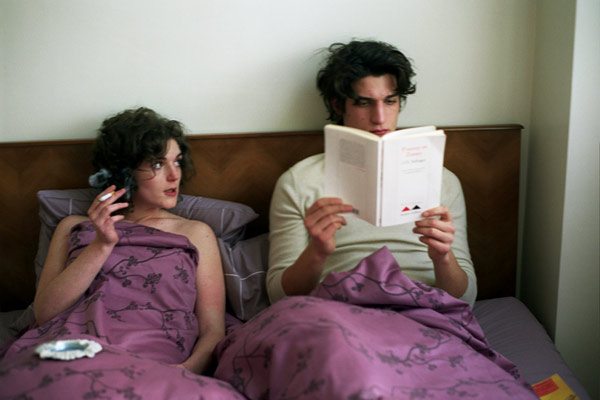
In what could be seen as a reply to the saccharine sweet (but oh-so-enjoyable) Paris, Je t’Aime, comes Inside Paris (Dans Paris), another film about relationships in the ‘city of love,’ but with a far rawer, and far more emotionally affecting, perspective. It opens with a series of twisting scenes depicting a disintegrating relationship. Capturing moments of aggression, heartbreak, thoughtfulness and regret, these scenes contort notions of reality in such a manner that audience members have no choice but to resign themselves entirely to the film’s relentless force and the confused nature of its storyline (and thus the confused nature of the protagonist’s mind.) This section forms a prelude to the remainder of the film, in which we see the main character Paul (Louis Garrel) leaves his girlfriend to live with his well meaning but confused father (Guy Marchland) and his hedonistic brother (Louis Garrel,) where he begins his journey out of depression.

The critics are celebrating Christophe Honore’s film for its distinctly “unpretentious” nature – if anything, this film is absolutely pretentious, and its jazzy soundtrack, poignant dialogue and twisting narrative attest to this. This, however, is not necessarily a bad thing, because this film’s pretentiousness nature is what gives it that distinctly French charm, without at all subtracting from the complexity of the characters and their healing processes. This film remains a thought provoking dive into the heart of depression, where anger, apathy and anxiety fight for dominance, and its pretentious sheen does in no way affect the film’s power to enthral and intrigue.

Rating: 7.0