Sunday, September 7, 2008

Funny Games

Austrian director Michael Haneke (Hidden) claims that his latest film, Funny Games (a shot-by-shot remake of his own 1997 German-language film) is a commentary on violence and the media, and on the way in which “American cinema toys with human beings… [and] makes violence consumable.” He argues that, through to-camera asides and “emotional episodes” he successfully subverts the genre, and makes the audience complicit in these characters’ violence. According to Haneke, if you see this film through to its conclusion, you’re actually jumping aboard America’s cinematic violence train and tooting its horn. And herein lies the messy contradiction; Haneke is adhering to the very mentality that he so vehemently critiques. Additionally, he hasn’t quite succeeding in obtaining that level of subversion that is necessary to make audiences aware of his message. Funny Games therefore ironically ends up as just another mad thriller, not unlike so many others produced in America.

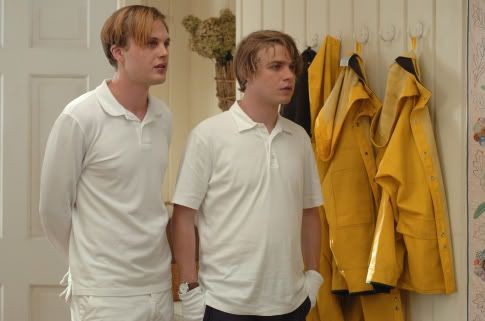
The film follows the affluent (and very white) Faber family as they arrive at an idyllic riverside holiday home. Annie (Naomi Watts), George (Tim Roth) and their young son Georgie (Devon Gearhart) begin their holiday in high spirits but soon find themselves unnerved by two overly polite yet unnervingly creepy boys who come over from next door, apparently in search of eggs. Dressed in white costumes that seem to eerily recall something of A Clockwork Orange, Paul (Michael Pitt) and Peter (Brady Corbett) make their intentions known soon enough; they find pleasure in psychological torture and gradually pump up the terror levels. Haneke doesn’t show any graphic violence on-screen, but this somehow feels all the more terrifying. Paul occasionally speaks to the camera, and these moments must be those ‘asides’ that Haneke believes subvert the thriller genre, but they’re not nearly great enough in number or effect to achieve anything significant. In the end, Haneke can intellectualise this terror as much as he wants, but that won’t change the fact that this thriller is ugly, terrifying and just as much entwined in the American cinematic apparatus as the next one. And where does that leave Haneke's philosophy?

Tuesday, September 2, 2008

Welcome to the Sticks


It's somehow strangely pleasing to discover that France's highest grossest comedy stars neither Gerdard Depardieu nor Daniel Auteil. Welcome to the Sticks (Bienvenue Chez Les Ch'its) instead cements the career of another French icon, successful comedian and actor Danny Boon (Joyeux Noel, Mon Meilleur Ami). As the writer, director and star of this film, Boon uses it to celebrate his beloved native region of Nord-Pas-de-Calais, located in the North of France. This area, which Boon so passionately adores, has traditionally been ridiculed for its unfriendly climate, its stinky cheeses and its peculiar dialect of 'ch'ti.' Welcome to the Sticks explores and challenges all these prejudices through Philippe (Kad Merad), a post office official who faces a disciplinary transfer into the region after he is caught trying to cheat his way towards the Riviera. His wife and son do not dare brave the freezing Northern climate and supposedly frightening locals, so Philippe goes it alone and, of course, discovers that the region is not all that meets the eye.

As with any standard French comedy, comedic deception abounds; Philippe's relationship with his wife has never been better, so, to ensure that she does not join him, he must keep prejudices undisturbed. You'll also find a sweet unrequited love sub-plot, a series of slowly-unfolding friendships and an underlying comedy of errors. In many ways, therefore, this film is not all that unique. Its phenomenal success in France can perhaps be attributed to its particularly relevant subject material, a lot of which is naturally lost in translation. Sub-titles may attempt to mimic that eccentric ch'ti accent, but ultimately this can only replicate a slither of the humour. There is just no way to translate all the cultural assumptions that surround this region and its dialect. Nonetheless, even on face value, this film is charming enough. Boon himself may not be that charismatic, but there is something quite charming about the good-natured characters that he has created, and their misguided stumbles through life’s obstacles. Welcome to the Sticks is easy to enjoy, even if, for Australians, it won’t really stand out from the plethora of French comedies that surround it.


Monday, August 18, 2008

The Visitor

In these troubled times, cinematic commentaries on American political issues are about a dime a dozen, but few have successfully lowered these global concerns to a personal level without becoming didactic, clichéd or self-conscious. Writer/director Tom McCarthy (The Station Agent) avoids all these trappings with his latest film, The Visitor, the simple story of a resigned academic who finds new passion and purpose through an unlikely friendship. It's through an unusual set of circumstances that Walter (Richard Jenkins, Six Feet Under) comes into contact with Tarek (Haaz Sleiman) and Zainab (Danai Guirira); they are victims of a real estate scam and living in Walter's New York appartment under the mistaken impression that he's aware of their presence. This comical beginning grows into a connection that swiftly reawakens Walter, musically, socially and politically.

To describe only The Visitor's storyline, however, is to do it a disservice. The film's success lies not so much in the plot as it does in its heartfelt script, subtle direction and touching performances. Even though the plot twists in all the expected directions and the characters all walk down predictable paths, McMarthy ensures that all these turns remain somehow surprising. There's a restraint to his writing that keeps every development devastating in its sheer believability. And, thankfully, even the most emotionally wrecking scenes are kept far removed from the kind of sensationalism that films such as this so often succumb to. The power of this film instead rests in subtleties; you'll see this in the gradual shift of Walter's posture, in the flickers of amusement that cross Tarek's face, and in those moments of despair that are marked only by silence. It's impossible not to be touched by this film; it's utterly devastating in its exploration of America's immigration policy, and yet somehow remains an uplifting story of human connection.

Tuesday, August 12, 2008

Far Away [theatre]

Caryl Churchill’s 2000 play Far Away opens not with a dramatic bang, but with a surreal calm, and a focus that marks this as one of her more intimate works. Theatre director John Sheedy paints the picture: “One of the first things audiences will see is this very quiet, elderly woman sitting there, darning a sock into a thing. It’s very simple, and it all unfolds and unfolds and unfolds and unfolds into something bigger and more complex.”

It unfolds into a work that twists theatrical convention and plays with audience expectation. Its neatly slides into the Black Swan Theatre Company’s varied 2008 programme, sitting alongside The Caucasian Chalk Circle as another example of 'Theatre that Challenges.' For Sheedy, “Caryl Churchill is one of the greatest British playwrights, because she’s always re-inventing form and function in her writing. She’s developed and always pushing the extreme, asking the big questions. They’re always, always political. She’s always speaking through the voice of the minority, through the little man and it’s mainly to do with women, because she’s a feminist writer as well.”

Sheedy describes Far Away as one of the first big steps in terms in what we perceive as a play, particularly in terms of its structure. It’s a play that jumps through time and space with no apology or explanation. “She makes giant leaps with nothing in between, and we’ve got to use our imagination to fill them,” Sheedy urges. “That’s what I love about her work, and particularly her later work, is that she’s forcing the viewer to use their imagination to fit in what’s happening in between – she doesn’t hand feed you the information.”

With a recurring interest in intertwining disparate realities, Churchill uses Far Away to slam together three separate scenes while eradicating any semblance of segue. The quiet first scene evolves into a conversation between the elderly woman and her little grand-daughter, Joan, but then, suddenly, there is a jolt into a future reality, where Joan now works with a friend in a factory, painstakingly crafting elaborate hats. Then, once more, the story lurches forward and into a landscape where the whole world is at war and Joan herself has become a leader in that conflict. “You don’t resolve [those shifts],” Sheedy emphasises. “Instead, you make them as bold and as clear and as definite as you can. You don’t apologise for it, as [Churchill] doesn’t in her writing.”

Churchill herself is also careful never to give away any clues, avoiding interviews and public appearance so that there can only be blind guesses as to her intention. “That’s what great about plays like Far Away, though, in a way when you don’t have all the answers there, and it’s a blank canvas with a big idea, it’s how you interpret it and what you discover and what you unpick,” explains Sheedy. “And there’s an amazing cast that I have, and they also discover stuff with you. I go in there having a fairly good idea of what she’s saying in this piece of writing and I also have a very strong vision to take the team through, but of course they always add and they add, which is wonderful. It’s one of those tricky plays, as we’ve discovered, just when you think you know what it’s about and you’ve nailed it, you go back one step and you go, ‘Actually is it this?’ And you have another question about it, and then you think you’ve sold that and you discover you’ve got another question. It’s wonderful though too, it’s exciting.”

It’s the kind of play that offers its director room to move through visual and technical experimentation. Sheedy is careful not to give too much away but mentions that the company has described his interpretation as “a mini opera,” and that it includes fifty choreographed extras as well a “large visual object.” He’s quick to assert, however, that this freedom is not absolute. “Visually yes, absolutely, you have that freedom, but… the language is so honest and so, I guess, that text, because it’s so descriptive the language, you’ve got to make sure you’re on the money and you’ve got it right so you don’t really have the freedom there. It’s the honesty, the absolute honesty of that voice, you can’t deny it and it’s terrifying to work on. It guides you so clearly and grabs hold of you and really tells you where to go.”

For Sheedy, this text is a blur of challenges and didactic intent. It’s a story that’s topical in all its strangeness, questioning mankind’s current trajectory with a nod to the absurdity of recent wars. “Some [audience members] will change, hopefully,” Sheedy anticipates, “and think about their own value system and what they do in the world and how they partake as a human being on this planet. Others will be confused and they won’t get it, and that’s OK as well. When you’re talking about how the rocks at war with gravity and the grass is at war and the Koreans and the elephants are on one side and the cats are with the French and dentists are with pigs and you don’t know what side the river is on, that all sounds crazy but actually I know what she’s saying and it kind of makes sense when you read it or listen to it and you just stop and just actually absorb that information and the chaos.

“You go ‘OK, this is actually where we’re all heading.’ We’re so advanced technically, too clever for ourselves. We’ve not keeping things simple, we’re impatient and we’re developing every day. War comes with that as well. The more we want to own, the more impatient we become, the more we develop, the more confusing and complex we become, the more something shuts down because it’s too much. Where do we fit in the middle of that?"

For a fifty minute play, Far Away is dense with themes and questions. Sheedy’s advice is for audience members to just sit back and listen carefully, without necessarily seeking instant understanding. “You probably won’t even get an answer until the next morning when you wake up, or maybe even the following week,” he confesses. “I do believe that it’s one of those good pieces of writing that sit with you for over a week or two weeks afterwards. Like any good book or play or film that you see or read. A good story will sit with you and have an afterlife, whether you like it or not. And there will be people there saying ‘what sort of play is that?’ and there will be people who find it incredible. There is no in between with this play, and that’s what I find exciting.”
Monday, August 11, 2008

Female Agents

Female Agents is a perplexing film. On the one hand, through its sombre dedication, frequent date/time inter-titles and its opening montage of authentic WWIII archive footage, it implores audiences to recognise its ‘true story’ aspect. On the other, through its stereotypical characters, sensational narrative, and melodramatic developments, it makes that very difficult to do. Based very loosely on real-life French partisan Lise Villameur, the film follows Lousie (Sophie Marceau) and her brother (Julien Boisselier) as they lead a group of all-female agents into a Nazi-operated hospital to rescue a British geologist crucially involved in planning the Normandy landings, before the Germans have a chance to figure out why he was there.

Director Jean-Paul Salome has handled his action scenes with prowess; the film is full of taut, tense moments guaranteed to bring audiences to the edges of their seats. Beyond these moments, however, the film’s soundtrack and dialogue allude to a deep profundity that is actually notably absent. In its place is a sensationalist, and almost comcial, mellodrama that permeates practically every scene, whether the girls are orchestrating elaborate attacks in burlesque get-up, or engaging in far-fetched romantic exchanges. Furthermore, these female characters are actually almost offensive in their simplicity, each sitting on the far edges of that age-old madonna/whore dichotomy. The discoveries that they make about each others’ pasts are predictable and arguably unnecessary. In the end, the film fails dramatically at crafting any real drama or emotional involvement, and yet unfortunately it seems unwilling to identify simply as an action film.

Tuesday, July 29, 2008

The Bank Job


Surprisingly based on a true story, The Bank Job follows a group of amateur crooks who find themselves positioned as pawns in a series of political manoeuvres. MI5 up-and-comer Tim Everett (Richard Linten) is on a mission to retrieve highly incriminating photographs from a local bank vault, but the catch is that he can not leave behind any trace of his involvement. He operates through the street-savvy Martine Love (Saffron Burrows), and she’s the one who seductively lures Terry Leather (Jason Statham) and his friends out of small-time crime and into serious business. Throw in a Trinidadian thug, a manipulative bordello owner and a handful of corrupt police, and things are bound to get a little complicated. Full kudos are due to the screenwriters for negotiating this twisted storyline with such skill and flexibility. The Bank Job will sweep you up and into this fantastically convoluted journey, and yet it retains that rare ability to make an audience laugh at the sheer ridiculousness of its narrative.

Roger Donaldson’s directing is pitch-perfect. His last cinematic effort, The World’s Fastest Indian, was bloated by its own sense of self-importance, and was all about the heavy emotional scores, trite dialogue and tear-jerking character developments. Donaldson seems much more comfortable back in the action genre, working with a film that refreshingly operates under no such false pretences. From its title to final credits, The Bank Job is unashamedly a heist film, and we’re all the better for it. The characters are all recognisable (Tim Everett channels something of James Bond and every archetypical villain is present in full form), but somehow they become all the more enjoyable in their supposed realism. And, even though these criminals lack the pure charisma of Danny Ocean and co., there’s something quite amiable about their never-ending blundering and that manages to keep us on their side the whole way through. This is heist the way it should be; tense, yet not without a sense of fun.

Monday, July 21, 2008

The Savages


Initially, The Savages does not feel particularly special. The heavy tehmes channel that all-too-familiar vibe of emotional family dramas, while the characters' almost comical squabbles suggest the film might be destined to end up on that ever-growing pile of quirky indie comedies. The strength of The Savages, however, lies in its ability to play up to both these images at once; serving up refreshingly real humour alongside a delicate insight into old age and its impact upon family members. Two of Hollywood’s most intriguing actors, Laura Linney and Phillip Seymour-Hoffman, play estranged siblings who are forced back into each other’s lives after their father’s girlfriend dies, leaving him alone with steadily advancing dementia. In adulthood the two have grown apart, but this reunion forces them back into long-forgotten roles as they struggle to look after a father who could never take care of them.

Siblings offer a veritable minefield of subject material for filmmakers, yet they appear relatively rarely, and it is even rarer to find siblings handled with such nuanced realism. Writer and director Tamara Jenkins (The Slums of Beverley Hills) has managed to perfectly sculpt that dynamic which is so particular to siblings, seeping it into their every exchange and sideways glance. Linney and Hoffman are perfectly cast, and admirably manoeuvre through the contradictions and complexities at play in their relationship, as they simultaneously strive to prove themselves and to prove their apparent indifference. Alongside them, all the other characters and sub-plots fade into insignificance; even their father is nothing more than the catalyst that brings the two back together. Arguably, some will find this frustrating, but for those in search of a relationship portrait with some fine-tuned performances, The Savages delivers. Delicately insightful and quietly thought-provoking, it makes an ideal compliment to this wintery climate.