The actors all put in stellar performances, but somehow these characters remain seemingly inhuman. This is because director/writer Christopher Weeks allows them no human complexity; or, rather, because he does not allow us to see it. Even though this is essentially a film about emotion, we are allowed no glimpse of character’s inner lives. Weekes lingers solely on the exterior manifestations of these emotional states, which makes for a slow-paced and slightly depressing experience, with little reward. Films about hopelessness are rescued from drudgery when they provide some sort of insight into the human condition, or are at least emotionally powerful. Bitter and Twisted, however, remains a struggle, because there is little to be found here beyond a superficial meditation on sadness.
Tuesday, October 14, 2008
Bitter and Twisted
The actors all put in stellar performances, but somehow these characters remain seemingly inhuman. This is because director/writer Christopher Weeks allows them no human complexity; or, rather, because he does not allow us to see it. Even though this is essentially a film about emotion, we are allowed no glimpse of character’s inner lives. Weekes lingers solely on the exterior manifestations of these emotional states, which makes for a slow-paced and slightly depressing experience, with little reward. Films about hopelessness are rescued from drudgery when they provide some sort of insight into the human condition, or are at least emotionally powerful. Bitter and Twisted, however, remains a struggle, because there is little to be found here beyond a superficial meditation on sadness.
Sunday, June 15, 2008
Unfinished Sky
The fact that this Dutch story could so easily be transformed for an Australian audience raises some interesting points about our world’s shared experience of globalisation, and the universality of human connection. Sadly, the film is ill-equipped to deal with such meaningful messages. Yes, there are some lovely moments in the film (the chemistry between Tahmeena and John feels genuine), and certainly these are important and topical themes. It’s also refreshing to see McInnes to take on a new role (not the fast-talking journalist for once), and actually deliver a convincing performance as the stoic farmer. Beyond Tahmeena and John’s enthralling connection, however, the film feels cheap, as if underdeveloped. The secondary characters are all flat caricatures, the dialogue often feels contrived and stilted, and the inclusion of so many arbitrary flashbacks serves only to belittle Tahmeena’s traumatic past. With each new scene, the plot grows more and more unbelievable – watch out for Tahmeena’s almost instant grasp of English! When you’re noticing inconsistencies like that, you know the film has made a mistake somewhere along the line.
Sunday, November 25, 2007
Into the Wild; September
For the most part, this seemingly endless string of new experiences is exhausting. The cinematography may be breath-taking, but it’s doubtless that the film would have benefited from some far more severe editing. Its slow pace combined with the sheer volume of experience that director Sean Penn packs into this limited space is a little overwhelming. It has to be acknowledged, though, that like bathroom renovations, a history textbook or a week of exams, you won’t fully appreciate Into the Wild until it is over. It is also only with hindsight that the significance of scenes that had previously seemed arbitrary is made clear, transforming the film from a simple travelogue to a complex philosophical exploration of human nature. In the end, despite it being such hard work, Into the Wild is a profoundly worthwhile experience, and the film’s philosophical undertones are no difficult to quickly shake-off.
September is the first film to be produced by the Tropfest Feature Program – an incentive designed to extend Tropfest’s interest in exposing emerging talent (through its short film festival) to sustaining this talent through career support for new filmmakers. Indeed, September is powered by that feeling of freshness brought to it by Peter Castair’s youthful vision. The dialogue is refreshingly (and appropriately) sparse, while the meaningful silences are plumped by poetic cinematography. Low depth of field emphasises the character drama, and the powerful performances of the young leads (who are never overshadowed by their older counterparts). Some of the hand-held camera work feels a touch misplaced but there is something quite captivating about this slowly-unfolding drama. And if you’re worried that the ‘black and white friendship angle’ will veer into didactic preaching or trite cultural commentary, have no fear, because September is far from this. The thematic undertones of this narrative certainly transcend its 1960s context, but it remains nonetheless a realistic snapshot of Australia’s past, produced with the highest level of storytelling talent and artistic integrity.
Monday, November 5, 2007
Bomb Harvest
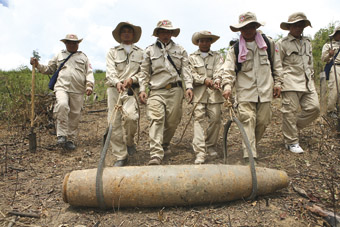
Simultaneously, though, this documentary maintains a grip on its more serious aspects. Asides provide an insight into one of Vietnam War’s lesser-known atrocities – the ‘secret war’ occurring across the border in Loas, named thusly because the American government of the time entirely denied its existence. Today, few people realise that Loas is the most heavily bombed area in the world. In particular areas, the number of dropped bombs actually exceeds the number of inhabitants. While pointing these facts out, Mourdaunt also cleverly breaks up the bomb team’s journey with news reports and presidential speeches from around the time of the Vietnam War, all of which echo today’s ‘just war’ rhetoric. Notably, there is no patronising narration present to point out the frightening comparisons. There doesn’t need to be; this movie’s footage speaks for itself. With only two screenings this weekend at Cinema Paradiso, it’s only a pity that more people will not be able to see the simple, but incredibly powerful, documentary.
Rating: 7.5
Monday, September 17, 2007
The Bet
“A broker. A banker. A bet.”
This tagline essentially summarises everything you need to know about the latest, privately financed, film from director Mark Lee (Gallipolli). You won’t gleam much more from actually watching it. Matthew Newton (Looking for Allibrandi, and, more famously, Bert Newton’s Son) is the boyish-faced stockbroker from a working class background, Aden Young (Black Robe) his the cocky, affluent banker friend, and their bet is a 90 day race to see who can be the first to earn $100 000. And, yes, it’s refreshing that while most Australian films relish our country’s lost youths and our suburban misery, this one should jump into our upper class, where the characters play golf, buy diamonds and know exactly what they want out of life. It’s very possible that this film could have been intriguing insight into Australia’s fast paced stock market world, or a riveting financial thriller to rival Boiler Room, or its closest Australian counterpart, The Bank. Unfortunately, though, this film suffers from an irrational intensity, compounded by its percussive soundtrack, weighted dialogue and unnecessarily prologued close-ups. Additionally, while Neweton’s broker does occasionally elicit flickers of empathy, the other character characters (in particular Young’s banker, Angus) are infuriatingly shallow. These characters are one-dimensional ciphers, existing merely to propel the heavy-handed narrative.
Rating: 4.2
Wednesday, September 5, 2007
The Jammed
These past few years have seen Australian cinema grow darker than ever before, boldly exposing our cities’ dark underbellies, and fearlessly diving into the previously unexplored or unacknowledged echelons of our society. Inspired by true events, The Jammed is another Australian release that treads where no other films have tread before; exploding into the violent reality of Melbourne’s sex trafficking industry. Director Dee McLachlan cleverly juxtaposes two vastly different worlds by interweaving the story of Ashley (Veronica Sywak), a restless, middle class, insurance company employee, with the story of Crystal (Emma Lung), a recently arrested, Indonesian sex slave about to be dumped in a detention centre because of her expired visa papers. These two worlds collide when Ashley finds herself reluctantly assisting Sunnee (Amanda Ma), a Chinese woman on a desperate search to locate her missing daughter, who they soon learn is now a sex slave working alongside Crystal.
Interestingly, The Jammed was rescued from obscurity only because of the wildly positive reaction it provoked during its (extremely limited) initial release. Some of these reactions do seem excessive, as the film is far from perfect. Its exposition suffers from uneven chronological jumps and generally stilted dialogue and performances. Both the plot and the actors actually take quite a while to warm up, significantly affecting the story’s emotional impact. Even when the film eventually eases into a more natural rhythm, it does tend to dip into unrealistic action sequences and to falter under the weight of a very distracting, overly sentimental score. At the same time, though, there are some brilliant performances in this film (the stand-out being Saskia Burmeister, who is virtually unrecognisable as the Russian prostitute, Vanya,) and the story itself, while perhaps a little convenient, is also admittedly enthralling. Moreover, with Australia listed as the tenth main destination for sex traffic victims, this is a particularly relevant film, and you can’t help but admire McLachlan’s gutsy attempt to highlight this issue. Even though this is not brilliant cinema, this is one of those films with a story that is truly worth telling.
Rating: 8.9
Friday, August 10, 2007
Interview with Rolf de Heer
Rolf de Heer has never been one to linger on the lighter side of life. With a portfolio that encompasses Bad Boy Bubby, Alexandria’s Project and, most recently, Ten Canoes, de Heer has always layered his projects in heavy themes or politically charged messages. His latest directorial effort, however, symbolises a break in this pattern. Dr Plonk, a black and white silent film about a mad scientist, is a light-hearted comedic romp through time and through genre. There is nothing serious about this film; Dr Plonk merely offers audiences an excuse to laugh at some traditional slapstick humour.
The natural lightness of this film makes it remarkably easy to digest, and there is an accompanying sense that the entire production process was similarly organic. Indeed, de Heer describes the creative process as “a series of lightbulb moments.” He was first struck by the concept of silent film after stumbling across some old, unused film stick in his office fridge during the post-production of Ten Canoes. Then, barely an hour later, he recalled local street performer, Nigel Lunghi, who he’d seen busking in the Adelaide city streets, realising that he would be ideal for the role of the main character. “These things are very peculiar in how they happen. Often they don’t happen so quickly, but in this case they did,” he remembers, “I [found that film stock] and it was old and out of date and useless for anything, but in that moment I saw unspool in front of my eyes, in all its likely imperfections; silent black and white comedy. And in that moment, what was probably just two or three seconds, I went ‘Ha! I know what we’re doing next.’”
Casting a street performer rather than an actor would seem a risk to any conventional director, but de Heer rightly insists that he made the correct choice. “He has great physical skills, and he was the first person who I thought of when I thought of the film,” de Heer explains, “I thought, ‘I will use him somehow,’ and the character was formed once he was cast.” Additionally, Lunghi brought a whole range of physical skills to the set, which ideally complimented the acting prowess of Paul Blackwell and Magda Szubanski in supporting roles. De Heer confirms, “All three of them are quite different in the way they approach things, but in terms of character that worked and they were really able to help each other. Magda would suggest something and then Paul would take that further and then Nigel would suggest something out of left field. And it was a really great process, just collaborating with actors to get to where we got to.”
A greater challenge would be injecting contemporary relevance into a form that does feel quite archaic, although de Heer insists that comedy transcends history. “Anything that makes me laugh, does not feel dated,” he stresses, “You get some romantic dramas from that time and they do feel dated, because the attitudes are so different and so sentimental. But the comedies are composed of classic comedic routines, and these make people laugh then, and still do now.”