Showing posts with label drama. Show all posts

Sunday, May 4, 2008

The Counterfeiters


Oscar winning Austrian drama, The Counterfeiters, is a film that asks questions. It asks when morality becomes martyrdom, and when self-preservation becomes self-destruction. Set during the dying days of World War II, the film is about Operation Bernhard; the Nazis’ plan to flood and destroy British and American economies by falsifying enormous amounts of authentic-looking currency. In order to do this all Jewish prisoners skilled as graphic designers, printers, painters or bankers are transferred to Sachsenhausen concentration camp. Amongst them is Berlin’s most talented pre-war counterfeiter, Salomon Sorowitsch, and Adolf Burger, a passionate Communist who was arrested for producing anti-Nazi posters (who actually wrote the book on which this film is based). These emaciated, wounded individuals are drawn into a comparative luxury when they arrive at Sachsenhausen, where they are presented with clean sheets and a ping pong table as motivational ‘incentives.’ Therein lies the moral quandary – how can these men enjoy their relative comfort when prisoners are being tortured within their earshot?

The film is sharply confronting, but in a powerfully original way. Rather than showing us the terror of the camp through onscreen violence, the message of horror is conveyed through torturous ironies – the prisoners, for example, break down with shocked surprise when they are taken into a shower block, only to actually be bathed in hot water. It’s also a film that does not deal in the black and white dualities that usually accompany war dramas, but rather skips through a whole multitude of grey shades. Each new character is another complex individual, battling to figure out what they believe is right. The conflict between Sorowitsch and Burger is a fascinating picture of clashing moralities, presenting two men with such different ideas but equally honourable intentions. Some moments of dialogue do jar, but on the whole this is a gripping drama, and it goes some way to proving that no matter how many wartime films are made, there really are always more stories waiting to be told.

Rating: 9.0

Sunday, September 30, 2007

Away From Her

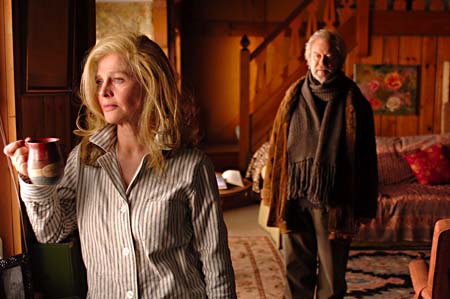
Sarah Polley seems an unlikely candidate for the direction of a film about old age. Having began her film career as a child television actor, the sprightly 28 year-old Canadian has spent the rest of it skipping through various acting instalments – most notably her touching portrayal of a mother dying from cancer in My Life Without Me. Stepping behind the camera for the first time, Polley tackles surprisingly similar themes in Away From Her, but this time her focus has skipped backwards a generation. The main characters are in their sixties, and this time Alzheimer’s is the destructive force slowly erasing its victim. After a 44-year marriage, Grant (Gordon Pinsent) has to cope with the gradual mental dissent and institutionalisation of his suffering wife, the eccentric and beautiful Fiona (Julie Christie).

Based upon the short story “The Bear Came Over the Mountain,” Away From Her sounds simplistic when described on paper – and to a certain extent this initial judgement remains correct. Yet, though the drama may remain relatively straight forward, Polley effectively steers it away from all expected clichés and potentially maudlin developments through a series of subversive narrative turns. What’s more, this uncluttered narrative has obviously allowed Polley room to move. She has unearthed a rich complexity from the space between the lines, inscribing a multi-layered complexity upon every pause in the script.

And, in the end, the strength of Away From Her lies not in its thought-provoking dialogue or in its richly crafted characters, but in its visual impact. In the way that Christie’s face flickers elusively between recognition and confusion. In the soft edged pastels of Grant’s flashbacks, toned with nostalgia and regret. In the heart wrenching devotion with which he observes his wife from afar. And in the palpable distance that slowly wedges itself between them, like an invisible current subtly pulling them apart. These are the images that will remain with you days after seeing the film, infused with a seemingly unaltered emotional impact. This is a rare gem of a film, but please remember to bring tissues with you. Trust me.

Rating: 9.4