Showing posts with label russian cinema. Show all posts

Monday, November 10, 2008

Russian Resurrection Film Festival Reviews


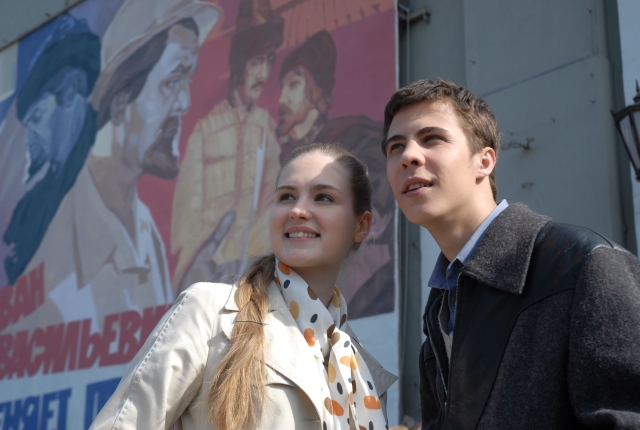
This year’s Russian Resurrection Film Festival is as topical as ever, delivering a showcase of new Russian cinema that is dominated by social and political commentary on the country’s past and present. A highlight includes Karen Shakhnazarov’s most personal film to date, Vanished Empire. Essentially, this film revolves around a dramatic love triangle between three Moscow university students, but the historical period within which these students live shapes much of their character development. Set in the early 1970s, during the peak of Soviet power, Vanished Empire is a nostalgic return to an exciting adolescent past, and to the calm before USSR’s deterioration. This film succinctly captures the challenges that were already influencing everyday life (when Pink Floyd records and label jeans were available only through the dodgy black market), while also weaving in a growing sense of foreboding. It is easily one of the festival’s most watchable offerings, with a touching central storyline and some very relatable characters.

Captive is more explicitly political. From director Alexei Utichel (whose films Dreaming of Space and The Stroll have been featured in past Russian festivals), Captive exposes the folly of the recent Chechen war by portraying meaningless violence, death and destruction from all sides. While some knowledge of the conflict is probably desirable for a more worthwhile viewing experience, it is easy enough to follow the film’s central narrative. A group of Russian soldiers has been isolated in unfamiliar Chechen territory, and two of their number, a responsible commander and an impetuous snipper, have been left with the responsibility of locating a local guide to facilitate their escape. They seize a Chechen boy, but, in the process of drawing him back from the village to their troupe, an interesting rapport develops between the three, with some unexpected consequences. This film makes emotional involvement very difficult, with plenty of dislocated dialogue and long, meandering scenes of silence, so you’ll need to be in the right state of mind. Its conclusion is extremely powerful, though, and its message very important. At just over an hour, Captive presents but a small slice of the tragedy that that has plagued that area in recent time.

The (post-)courtroom drama, 12, also touches upon the Chechen conflict, by exploring its impact upon racial attitudes in contemporary Russia. From director Nikita Mikhalkov (who received an Oscar nomination for Burnt by the Sun), 12 is a distinctly Russian adaptation of Sydney Lumet’s 12 Angry Men. Based around a similar premise, it begins just after courtroom proceedings, as a group of 12 middle-aged male jurors are left alone to reach a unanimous conclusion. Unlike the original, however, where the accused is of African American descent, the accused is now Chechen, and therefore inspires similarly racist sentiments from some of the men. Only one of them is brave enough to speak out in the boy’s defence, but in doing so he provokes the other 11 jurors to think in more depth about the case. As they look further into the intricacies of the accusation, the men also reveal more about themselves and their personal pasts; each of them has in some way been touched by Russia’s tumultuous history. Intriguing up to its finish, 12 ideally captures the pervasive nature of the past. With some fascinating revelations and some solid performances, this film is a real festival highlight.

Monday, October 8, 2007

Interview with Nicholas Maksymow

No film student worth their salt could deny Russia’s epic influence upon cinema history. It was here that montage techniques were first pioneered and refined, and it was here that some of film history’s greatest masterpieces were born. So many years and one iron curtain later, and Russia is again eager to reassert its position on the international cinema landscape. The 2007 Russian Film Festival Russian Revolution is a tribute to Russia’s fast growing cinema industry, and, this week, it makes its way into our part of the globe.

“Russia’s film production is increasing at an incredible rate!” exclaims the festival director, Nicholas Maksymow, “Firstly, there are lots of private bodies who provide funding for budding filmmakers, and if that does not work there is always the state funding board. What’s happening there now is similar to what the AFI did in the late seventies to revive the Australian film industry. There’s this strong, creative reenergising.”

Luckily, Russian filmmakers are also enjoying a lucrative success at the Russian box office. This year they are expected to retain over one quarter of the total national box office takings. “Unlike Australians, Russians don’t really experience that kind of ‘cultural cringe’,” explains Maksymow. “There really isn’t a pressure to be Western, because Russians are so proud of all their art and above all their cinema… Films like Daywatch and Nighwatch and Wolfhound are obviously Russian films trying to copy Hollywood, but there is still this unique ‘Russianness’ about them, and there’s no pressure to get rid of that. In fact, that’s why people seem to enjoy them so much.”

Maksymow connects this sense of “Russianness” with the Russian artistic drive to paint realistically complex pictures of daily life, that accurately scan the whole range of the emotional spectrum. “For instance, in one movie you might cry, you might laugh and you might feel scared,” he emphasises, “There is so much emotion going through one film and that’s what life is like in Russia at the moment, because it’s so unpredictable. In everyday life people go through both laughter and hardship, and Russian film is all about capturing that realistically.” At this point, he laughs about how the highest rating Australian film to have ever been screened in Russia was Lantana – a fact that he attributes to Lantana’s complex, realistic, and unquestionably dark, treatment of human emotions.

If there is one section of human life, though, from which Russian cinema steers clear, it is contemporary Russian politics. While the world reels in response to news about Russia’s (often brutal) censorship of political journalism, the film industry is safe in its detachment. Maksymow explains, “The journalists get into trouble because they’re overtly political, and trying to push a certain view, while cinema is still seen as a democratic form of the arts, in the sense that it’s not really political at all. Filmmaking doesn’t really touch sensitive political issues in Russia; it’s more about making fun of the old politicians and examining our past than looking at the contemporary situation.”

Cinema and politics therefore enjoy mutual support and respect in Russia, a phenomenon reflected by the fact that Vladimir Putin (the Russian first head of state to ever visit Australia) officially opened the festival in Sydney last week. Significantly, Putin’s visit to Australia (for the APEC summit) corresponds with the 200 year anniversary of Australia’s relationship with Russia. Maksymow ponders on how all these aspects work together to strengthen international cultural understandings, as he reflects, “While obviously our relations, and Putin’s visit, have been mainly political and economic… festivals like these fill in the cultural aspects… I believe that what we’re trying to do by having Russian film festivals in Australia is giving not only those of Russian heritage, but also Australian citizens, a chance to see something they would not usually see.”

Monday, September 10, 2007

Russian Film Festival Reviews


This week, for the first time in Perth, Cinema Paradiso will host the Russian Film Festival, Russian Resurrection. One film enjoying its world-wide premier as part of this festival is Vitali Melnikov’s Beat the Enemy. Set in the waning months of the Second World War, this film charts a communist propaganda group, hastily assembled from mismatched exiles and actors, as it travels down a remote Siberian river. Stopping at various isolated communities, the group’s task is to glorify Soviet military feats through an eclectic fusion of song, dance, music, theatre, art and silent film. What begins as a seemingly simplistic narrative quickly develops into a rich tapestry of wildly variable encounters and gradually shifting relationships, that all come to a head when the team’s vessel floods, and they find themselves isolated on one of the river’s sparsely populated islands.

Whether they be propaganda projects or powerful post-war reflections, Russia has always been renowned for its war films, and for its treatment of wartime themes. While not set on the frontline, Beat the Enemy is a powerful and appropriately complex exploration of the war’s impact in Russia, and of this tremulous transition period in Russian history. By introducing so many varied local communities, the films scans the whole register of emotional responses – from the devoted Communist youth leader who barks orders at her inferiors and cries over the propaganda footage, to the old woman forced to saw the crucifix off her local chapel as it becomes a Communist ‘activities’ hall,’ to the German exiles suspended in limbo between two identities. But what truly rescues this film from mediocrity is the complex development of its five main characters. These characters shift unpredictably as the narrative progressions, and, even though this results in a far less concise narrative, their rapid mood swings are indulged and given full reign. The result is a film that is touchingly realistic, and thought-provoking in its density. Produced in grey tones and adhering to all classic conventions, this is no cinematic marvel, but it is an intriguing character study, tinted with an emotional variety that marks it as uniquely Russian.

Far less successful is Heat, Russia’s miserable attempt at romantic comedy. Set in the midst of a stifling Russian heat wave, this film sees four school friends reunite several years after graduation. These men are clearly meant to symbolise a cross-section of Russian society, with the navy boy, spoilt rich kid, aspiring actor and black ‘gansta’ all represented. This mix of characters feels painfully contrived, and the narrative developments seem to only emphasise this self-consciousness. This feels like a film that is desperately trying to represent modern Moscow as a space that is “Western-yet-still-distinctly-Russian,” but its desperation to do so results in it failing miserably, both as a tourism advertisement and as a film.

The narrative itself is wildly ridiculous, and not even in a pleasingly post-modern or seductively surrealist manner. It’s just plain silly. Somehow, all the characters end up going their separate ways and finding themselves on madcap, screwball adventures that transport them alternately through prison cells, nightclubs, penthouses, film sets, construction sites, mafia meetings and underpasses guarded by violent street gangs, where they alternately encounter romance, career development, violence and party. To make matters worse, this narrative is portrayed in the clumsiest, messiest manner imaginable. The varying sub-plots are confusingly interwoven so that it’s difficult to tell what is what and who is who, reducing the film to a convoluted mass of unbelievable city encounters. It’s impossible to make sense of this chaotic offering, and one hopes that this film reached number one at the Russian Box Office only because the same people saw it repeatedly, in the hope of uncovering some semblance of meaning.

Beat the Enemy: 6.5
Heat: 2.0

Sunday, September 9, 2007

Interview with Nicholas Maksymow


No film student worth their salt could deny Russia’s epic influence upon cinema history. It was here that montage techniques were first pioneered and refined, and it was here that some of film history’s greatest masterpieces were born. So many years and one iron curtain later, and Russia is again eager to reassert its position on the international cinema landscape. The 2007 Russian Film Festival Russian Revolution is a tribute to Russia’s fast growing cinema industry, and, this week, it makes its way into our part of the globe.

“Russia’s film production is increasing at an incredible rate!” exclaims the festival director, Nicholas Maksymow, “Firstly, there are lots of private bodies who provide funding for budding filmmakers, and if that does not work there is always the state funding board. What’s happening there now is similar to what the AFI did in the late seventies to revive the Australian film industry. There’s this strong, creative reenergising.”

Luckily, Russian filmmakers are also enjoying a lucrative success at the Russian box office. This year they are expected to retain over one quarter of the total national box office takings. “Unlike Australians, Russians don’t really experience that kind of ‘cultural cringe’,” explains Maksymow. “There really isn’t a pressure to be Western, because Russians are so proud of all their art and above all their cinema… Films like Daywatch and Nighwatch and Wolfhound are obviously Russian films trying to copy Hollywood, but there is still this unique ‘Russianness’ about them, and there’s no pressure to get rid of that. In fact, that’s why people seem to enjoy them so much.”

Maksymow connects this sense of “Russianness” with the Russian artistic drive to paint realistically complex pictures of daily life, that accurately scan the whole range of the emotional spectrum. “For instance, in one movie you might cry, you might laugh and you might feel scared,” he emphasises, “There is so much emotion going through one film and that’s what life is like in Russia at the moment, because it’s so unpredictable. In everyday life people go through both laughter and hardship, and Russian film is all about capturing that realistically.” At this point, he laughs about how the highest rating Australian film to have ever been screened in Russia was Lantana – a fact that he attributes to Lantana’s complex, realistic, and unquestionably dark, treatment of human emotions.

If there is one section of human life, though, from which Russian cinema steers clear, it is contemporary Russian politics. While the world reels in response to news about Russia’s (often brutal) censorship of political journalism, the film industry is safe in its detachment. Maksymow explains, “The journalists get into trouble because they’re overtly political, and trying to push a certain view, while cinema is still seen as a democratic form of the arts, in the sense that it’s not really political at all. Filmmaking doesn’t really touch sensitive political issues in Russia; it’s more about making fun of the old politicians and examining our past than looking at the contemporary situation.”

Cinema and politics therefore enjoy mutual support and respect in Russia, a phenomenon reflected by the fact that Vladimir Putin (the Russian first head of state to ever visit Australia) officially opened the festival in Sydney last week. Significantly, Putin’s visit to Australia (for the APEC summit) corresponds with the 200 year anniversary of Australia’s relationship with Russia. Maksymow ponders on how all these aspects work together to strengthen international cultural understandings, as he reflects, “While obviously our relations, and Putin’s visit, have been mainly political and economic… festivals like these fill in the cultural aspects… I believe that what we’re trying to do by having Russian film festivals in Australia is giving not only those of Russian heritage, but also Australian citizens, a chance to see something they would not usually see.”