Monday, August 20, 2007

Home Song Stories


As the AFI awards draw ever closer, Australian films begin attracting more and more attention to themselves, and the latest horse out of the gates is Home Song Stories. Based upon the true childhood experiences of writer/director Tony Ayres, this film is essentially comprised of the memories of Tom (Joel Lok), who, as a young boy, found himself growing increasingly disenchanted by his unstable, slowly disintegrating mother, Rose. Brought to life by the formidable Chinese starlet Joan Chen (best known to Westerners as Josie from Twin Peaks), Rose is a veritable fire-cracker of a woman, shifting violently through partners and plans, exploding without warning and dragging the torn remnants of her family behind her. She is utterly unsympathetic, but also completely intoxicating, enlivening the film with her fiery temperament.

Ayres’ attention to detail in this film is nothing short of sublime. Reconstructed from his personal photo collection, the set and costume design instantly draw audiences into his 1960s reality. The soundscape is equally fascinating, with every background sound, from the slightest bird chirp to the loudest car engine, clearly polished to perfection. Ayres himself has commented upon how the sound detail was designed to reflect the way in which memories capture only particular sounds, while entirely disregarding others, and, once you notice this, it is extremely effective. The narrative core, however, is not quite as imaginative, and, though it may seem facile to say this about a true story, rather repetitive. Ayres’ use of flashbacks and dream sequences does little to revive the story’s flavour, and in fact seem rather at odds with the rest of the film’s style. Nonetheless, Ayres’ ability to cloak the entire film in an appropriately childish honesty is commendable, and does provide a layer of complex contradiction which cancels out the story’s tendency to lag. Furthermore, Chen alone is a pleasure to watch, as she maintains the film’s energy levels throughout and vigorously drives the narrative towards its powerful conclusion.

Rating: 8.6

Sunday, August 19, 2007

The Boyton Beach Club


The Boyton Beach Club will not suit all tastes. Easy to enjoy, but difficult to rave about, it is well suited to those of a tranquil disposition who are easily amused by gently predictable humour. From director Susan Seidelmer (Desperately Seeking Susan), this is not a particularly ambitious project, but a simple story about the intriguing relationships that develop between a group of widowed senior citizens, united by their weekly participation in the Boyton Beach Club’s “bereavement group.” Here, the angsty Marilyn (Brenda Vaccaro) befriends the vivacious, lipo-suctioned Louis (Dyan Cannon), while the grieving Harry (Joseph Bologna) slowly re-enters the dating world with Sandy (Sally Kellermen). There is a certain spiritedness to these, and all, the relationships portrayed, enhanced by the fact that each of the actors’ injects their character with a significant dose of youthful energy.

Indeed, this film’s most endearing feature is the bizarre way in which it seems to, in many ways, mirror an American teen movie. There are social alliances, girly gossip sessions, first dates, penis jokes and “first time”-esque sexual anxieties, and there is even a prom at the end of it all. The unfortunate by-product of this, though, is the fact that the film manages to remain utterly devoid of any remotely poignant commentary about the aging process. Instead, it’s just another movie about twisted relationships and the difficulties involved in getting them up and running (in more ways than one, nudge nudge). Essentially, it’s a pretty empty film and, if it weren’t for the fact that there are no cast members under 55, it would instantly slide into obscurity. It’s one to file just above the irritatingly slow On a Clear Day, but quite a far way below the memorably effervescent (and actually genuinely touching) Calender Girls.

Rating: 5.5

Sunday, August 12, 2007

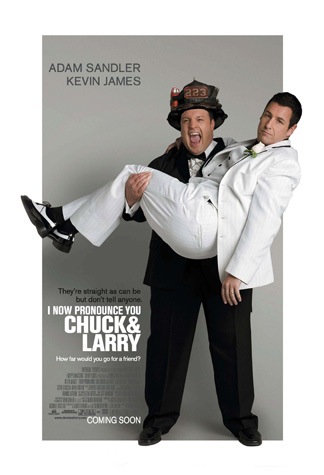
I Now Pronounce You Chuck and Larry

Imagine the worst possible form of celluloid torture. Imagine tasteless, dated stereotypes mixed with the most basic, lowest-common-denominator type of humour. Imagine two hours of cringe-worthy dialogue that will leave you confused as to why the cinema is actually alive with scattered laughter (is Australia really that stupid?). We’ve all seen these kinds of movies before; their mind numbing plot twists and their flinch-inspiring jokes are painful in their eerie familiarity. These are the kind of movies that inspire people to leave cinemas before their conclusions, and occasionally result in moderately amusing conversation starters. I Now Pronounce You Chuck and Larry is the quintessential example of this type of cinema.

From its introduction, this film’s tone is inscribed clearly into every shred of dialogue, every plot ‘development’ and every new character. The tone is one of painful, base humour, and ridiculously overused (and often very dated) stereotypes - exemplified right from the kick-off, with the ‘typical’ “bodacious female twins make out for the pleasure of the male protagonist” opening scene. From there, the concept is that Chuck (Adam Sandler) and Larry (Kevin James), two uber-heterosexual firemen, must feign homosexuality in order to obtain a gay marriage and thus ensure that the children of the recently-widowed Larry would be protected, were he to die as part of his particularly dangerous day job.

This is a film with its heart in the right place – but these good intentions are heavily misguided. While the film attempts to dress up its conclusion in pride symbols and pro-equality rhetoric, the very fact that Chuck and Larry are actually straight really does make a mockery out of the concept of same-sex marriage. Why on earth would the gay community be so supportive of two people who are abusing, and essentially ridiculing, the rights that they have worked so hard for? The film seems to completely ignore this gaping contradiction. Furthermore, every single gay cast member is a flat and predictable cliché, and homosexuals aren’t the only ones to suffer from what could only be described as a ‘pre-pubescent’ sense of humour. Obese people, Eastern Europeans, the homeless and (especially) Asians are all tarnished with the same brush in this film. Let’s just say that I would rather adopt a false sexual identity for the rest of my life than sit through this piece of tripe again.

Rating: 2.0

Die Hard 4.0


Thanks to that recognisable quality of heart and humour, the Die Hard franchise has become perhaps one of the most well-respected amongst the action genre today. In Die Hard 4.0, as in the movie’s predecessors, loveable trademarks are yet again present. The movie has once more captured Bruce Willis’ pleasingly believable flinching, his endearing mid-violence commentary, and a sense of the ridiculous mixed with the gritty. In a distinctly post-9/11 ‘virtual terrorist’ landscape, this time McClane (Willis) battles against an enemy he can’t see; a group working to bring down the American infrastructure from within its computer networks, by systematically shutting down everything that the nation has come to rely on (electricity, connectivity, economy and all emergency services). In other words, they are initiating a “fire sale,“ where “everything must go.”

Along the way, the villains call upon every ignorant computer geek they can find, positioning them as pawns or distractions within the grand plan. This is how McClane finds himself accompanied by the computer-savvy Matthew Farrell (Justin Long) – a talkative nerd almost as endearing as McClane himself. Together, they are an odd pairing but have a strangely appealing chemistry that propels the movie and provides relief from the occasionally excessive action sequences (watch out for car/plane and fighter jet/truck face-offs). Though, then again, to complain of Die Hard being excessive is to entirely miss its point. While this movie may at times be so ridiculous it will cause you to laugh rather than to flinch, this has always been the case with the series. In a way, this outrageousness (sprinkled with heart, humour and grittiness) has always been one of the features responsible for rendering the series so distinctly accessible. And we should all be relieved by the fact that these familiar qualities remain just as fresh, exciting and enjoyable as they were four films ago.

Rating: 7.9

Friday, August 10, 2007

Interview with Rolf de Heer

Rolf de Heer has never been one to linger on the lighter side of life. With a portfolio that encompasses Bad Boy Bubby, Alexandria’s Project and, most recently, Ten Canoes, de Heer has always layered his projects in heavy themes or politically charged messages. His latest directorial effort, however, symbolises a break in this pattern. Dr Plonk, a black and white silent film about a mad scientist, is a light-hearted comedic romp through time and through genre. There is nothing serious about this film; Dr Plonk merely offers audiences an excuse to laugh at some traditional slapstick humour.

The natural lightness of this film makes it remarkably easy to digest, and there is an accompanying sense that the entire production process was similarly organic. Indeed, de Heer describes the creative process as “a series of lightbulb moments.” He was first struck by the concept of silent film after stumbling across some old, unused film stick in his office fridge during the post-production of Ten Canoes. Then, barely an hour later, he recalled local street performer, Nigel Lunghi, who he’d seen busking in the Adelaide city streets, realising that he would be ideal for the role of the main character. “These things are very peculiar in how they happen. Often they don’t happen so quickly, but in this case they did,” he remembers, “I [found that film stock] and it was old and out of date and useless for anything, but in that moment I saw unspool in front of my eyes, in all its likely imperfections; silent black and white comedy. And in that moment, what was probably just two or three seconds, I went ‘Ha! I know what we’re doing next.’”

Casting a street performer rather than an actor would seem a risk to any conventional director, but de Heer rightly insists that he made the correct choice. “He has great physical skills, and he was the first person who I thought of when I thought of the film,” de Heer explains, “I thought, ‘I will use him somehow,’ and the character was formed once he was cast.” Additionally, Lunghi brought a whole range of physical skills to the set, which ideally complimented the acting prowess of Paul Blackwell and Magda Szubanski in supporting roles. De Heer confirms, “All three of them are quite different in the way they approach things, but in terms of character that worked and they were really able to help each other. Magda would suggest something and then Paul would take that further and then Nigel would suggest something out of left field. And it was a really great process, just collaborating with actors to get to where we got to.”

A greater challenge would be injecting contemporary relevance into a form that does feel quite archaic, although de Heer insists that comedy transcends history. “Anything that makes me laugh, does not feel dated,” he stresses, “You get some romantic dramas from that time and they do feel dated, because the attitudes are so different and so sentimental. But the comedies are composed of classic comedic routines, and these make people laugh then, and still do now.”

De Heer then adds the point that silent film is not necessarily a “dated” form for all Australia’s cinema-goers. He emphasises the film’s success at Brisbane’s recent film festival, where it screened for an audience of school children. “At the end of the film there was a ‘Q&A’ and they started asking why nobody had talked in it,” he recalls, “And I realised that they had no history or knowledge of silent films, and so what I had to do was basically explain the history of film… I had made something that was completely new to them.” Perhaps cinema, like fashion, can only ever decorate recycled tropes, offering these as new products to generations who missed them the last time. Perhaps Dr Plonk really is to cinema what high waisted skirts are to fashion, except with more title cards.

Saturday, August 4, 2007


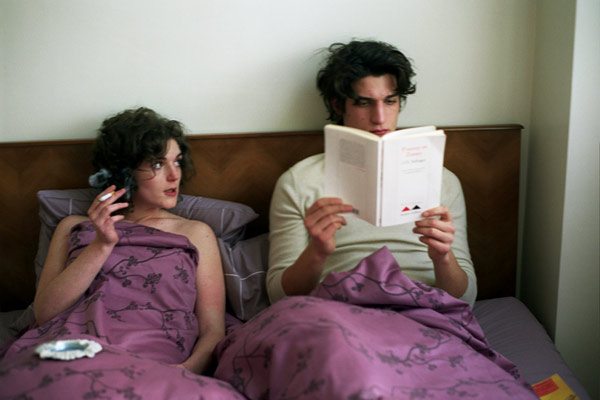
In what could be seen as a reply to the saccharine sweet (but oh-so-enjoyable) Paris, Je t’Aime, comes Inside Paris (Dans Paris), another film about relationships in the ‘city of love,’ but with a far rawer, and far more emotionally affecting, perspective. It opens with a series of twisting scenes depicting a disintegrating relationship. Capturing moments of aggression, heartbreak, thoughtfulness and regret, these scenes contort notions of reality in such a manner that audience members have no choice but to resign themselves entirely to the film’s relentless force and the confused nature of its storyline (and thus the confused nature of the protagonist’s mind.) This section forms a prelude to the remainder of the film, in which we see the main character Paul (Louis Garrel) leaves his girlfriend to live with his well meaning but confused father (Guy Marchland) and his hedonistic brother (Louis Garrel,) where he begins his journey out of depression.

The critics are celebrating Christophe Honore’s film for its distinctly “unpretentious” nature – if anything, this film is absolutely pretentious, and its jazzy soundtrack, poignant dialogue and twisting narrative attest to this. This, however, is not necessarily a bad thing, because this film’s pretentiousness nature is what gives it that distinctly French charm, without at all subtracting from the complexity of the characters and their healing processes. This film remains a thought provoking dive into the heart of depression, where anger, apathy and anxiety fight for dominance, and its pretentious sheen does in no way affect the film’s power to enthral and intrigue.

Rating: 7.0

This is England


Like so many films out there, This is England is another fine lesson in “don’t judge a movie by its promotional material.” The fliers will tell you that this is another ‘rite of passage’ classic, in which a young boy learns that 'violence is the coward’s answer,' while the trailer plays up the film’s isolated moments of heart-wrenching pathos, as if the entire film were focused solely upon the plight of its 12-year-old protagonist, Shaun (played to perfection by newcomer Thomas Tugroose.) In fact, Shaun is but a lens through which the audience is invited to view a far larger and more widespread predicament. From the start, he is a mere pawn in someone else’s toxic game play.

From its opening credits (a collage of authentic news footage), this autobiographical effort leaves no question of context unanswered. This is England is firmly rooted in the midst of Margaret Thatcher’s debilitating regime, during a time rife with hostility, racism, mass unemployment, xenophobia and lingering bitterness about the Falklands controversy. It is in this anxiety-ridden context that we meet Shaun; a scruffy, bullied adolescent struggling to cope with the recent death of his father. On his way home from school one day, the desperate Shaun is rescued by Woody (Joseph Gilgun), a skinhead with good intentions, and thus Shaun finds himself drawn into a world of shaved heads, Ben Sherman shirts, suspenders, Doc Martens, and much older girlfriends (in what is a bizarre but intriguing exploration of pre-pubescent sexuality.) The trouble begins when a much older member of the gang (Stephen Graham) is released from prison, and Shaun, vulnerable and naïve, is ideal prey for his hard edged, overtly racist preaching.

Shaun is the narrative’s catalyst, but in no way is he its central focus. Rather, this film is more of a portrait of the times. It at once conveys the passionate spirit and crushing desperation of the time, (a roughed up version of Degrassi High?), while simultaneously capturing all the period’s complexities; shifting notions of masculinity, the irreconcilable clash between racism and nationalism, and, yes, the complexity of growing up in a country so deflated by its own desperation. There are unnecessarily sappy moments within this film (the overtly emotional musical score is at times at odds with the hard-edged narrative, and some of the nationalist spiels are accompanied by cringe-worthy montages), but, on the whole, this is a deeply moving and highly powerful film. Arguably, this is Shane Meadow’s most mature, and most successful, cinema effort yet.

Rating: 8.0