Monday, March 2, 2009

Masala Bollywood Festival


While the world is going wild over India, it seems that India is going wild over the rest of the world, as illustrated in one of the Bollywood Masala Film Festival’s many romantic comedies, Kismat Konnection. This is yet another Bollywood production set almost entirely overseas, in which Toronto becomes an idyllic space of romance and passion. Here, the songs are performed at happening Western nightclubs, amongst flashing neon advertisements, and aboard river cruises. There are a couple of saris, but the majority of dancers seem to have discarded traditional Indian gear in favour of short skirts, baseball caps and denim. The storyline also seems to have taken some of its cues from recent American romances, like Lilo’s Just My Luck. Shahid Kapoor plays Raj, a promising graduate whose attempts at employment are constantly thwarted by poor fate, or kismat. This all changes when he literally runs into the beautiful (and already betrothed!) Priya (Vidya Balan). It seems like hate-at-first-sight for the two of them, but plenty of trite dialogue and emotional music help indicate the inevitable. Despite his better judgement, the struggling Raj quickly realises that Priya may well be some sort of lucky charm, and that it is only with her by his side that he will ever succeed. It’s in no way a particularly extraordinary film, but it is extremely watchable. Despite its typical three hour duration, the action is fast-paced, the dialogue is snappy and the musical numbers are well spaced-out, so the film thankfully does not feel its length. Kismat Konnection may serve as the perfect introduction to the Bollywood genre; light-hearted, a little daggy, very fun.

Race is also set beyond India – this time in the more affluent corners of South Africa, where brothers Ranvir (Saif Ali Khan) and Rajiv (Akshaye Khanna) both enjoy lives of excessive decadence. From the film’s opening shot, its style and pace are made clear. We see a slick blue car crash into a large truck, spin repeatedly through the air (thanks to some rather dubious CGI) and then crash upside down onto hard road below. The occupants remain anonymous, but we’re clearly expected to care about their identities. A fast-flicking, MTV-styled opening then introduces us to the main characters and their interests; extreme sports, horseracing, beautiful women and alcohol. From here on in, things get complicated. The film morphs into a series of implausible, unbelievable twists and turns, interspersed with scenes of Western glamour. There are huge racetrack parties, chandelier-lit balls, fashion parades, flawless suburbs, and luxurious cruises. There are broken hearts, fake relationships, multiple betrayals, murder plots, and excessive amounts of intrigue. Add a desperate secretary and a very intense police officer mid-way through, and the craziness just goes through the roof. With its non-stop intensity, implausible plot and excessively dramatic performances, Race is a real struggle. This film reeks of a very conscious attempt to recreate American action films, but it has failed to include any form of relief or character connection. Without any of that classic Bollywood comic relief, this is simply a contrived action film with a couple of saucy dance numbers.

Saturday, February 28, 2009

Anitgone [interview]

Anyone familiar with Schvendes will not be surprised to see the Perth band’s frontwoman Rachel Dease involved with a Greek tragedy. No stranger to the darker side of art, she has carved a reputation for herself as a lady of torch songs and sweetly threatening vocals. In Matthew Lutton’s contemporary adaptation of Sophocles’ Antigone, Dease seems at home, charting the play’s emotions through song – but these compositions are not quite as dark as could have been expected.

“I had to kind of leave all of my prejudice and my style, in a lot ways, behind,” Dease explains. “Even though melodically and harmonically and even lyrically to a certain degree they’re definitely the kind of songs I would write, they’re still different. I had to fill a role in that project.”

Dease’s songs with Schvendes have all been self-contained stories of misery, and their video clips have been sprinkled with gothic visions of smoky forests and deserted dolls. The minor, bluesy strains of these songs have on countless occasions been compared to Nick Cave and PJ Harvey, but Dease warns that the songs that she’s written for Antigone mark a departure from her usual style.

“I think that, because the play is really dark and powerful, I didn’t want to do the obvious and write really dark, gloomy, songs. I’ve really tried to play on my light side as much as I can, because it’s just too obvious and it’s just too much. I’ve noticed recently that there are a lot more major chords in Antigone than there in Schvendes – which I think I’ll probably stick with for a while. But I done it; I think I’ve nailed it.”

Dease also seems to have also extracted the positives from the story itself. As a classic tragedy, Antigone offers plenty of cause for despair. The play details Antigone’s unlawful attempts to respectfully bury dead brother after he has been declared a traitor, and her subsequent punishment. Dease argues, however, that even the play’s antagonist. Creon, can be seen positively.

“I think Antigone can a probably a role model for both males and females, in her strength and resolve, but I also think Creon is an unusual role model in many ways too, maybe more so than Antigone. Creon is someone battling with that timeless conflict between what we think is right for our society and what we truly believe, and that’s what Antigone is all about… Those base emotions make it so relevant to contemporary society and politics. They are the reason why it works to adapt this play, and to bring it into a contemporary context.”

In Lutton’s adaptation, traditional dialogue and story will meet modern set design, costume and music. Dease gushes enthusiastically about a stage covered in “blood, milk and snow,” but falters and stresses that the visual set-up can’t be adequately described without being seen.

“I’m very exciting about seeing it come together now, with the stage set-up,” she says. “I really love the mechanics of theatre and I’ve been loving watching [the set designer] bring it all together. I think if I wasn’t a musician I might want to do that - it’s like putting together a really intricate doll’s house… That’s a new thing for me, I didn’t think that before I got involved in this play.”

As Dease continues describing the backstage processes, she seems to become more and more enthusiastic. She paints a picture of idyllic collaboration and teamwork, with musician, director, set/costume designer and playwright gathering to discuss the characters and ideas, then to workshop the play repeatedly, until general consensus was reached.

“[Our opinions] always seemed to change, all the time!” she laughs. “Month after month we seemed to have different opinions on each character and who our favourite characters are. And I basically took several interpretations of the characters away and tried to get into the heads and the emotions and the thought processes of each of them.”

From there, Dease worked alone with the suggested ideas and overarching emotions to create appropriate songs. For her, such solitary composition was another first: “I felt quite isolated. I mean, in a band, we all bounce ideas off each other and we’re all musicians, and obviously we all have an idea of what she should sound like, whereas in this it became quite a solo process for a very long time. I’ve only just started working with the musicians quite recently.”

Dease expects that these experiences might influence her work with Schvendes: “I’ve definitely explored avenues that I probably wouldn’t have without doing this play, like the isolated writing, and I can’t see myself forgetting that. I think that might seep into the band.”

Despite these times of concentrated individual work though, Dease maintains that the intense period of brainstorming had an immeasurably large impact over her work. “I’ve never been involved in a project like this before,” she explains. “I was just really surprised that so many really different creative minds can work together and somehow produce a work that’s really quite unified. We haven’t had disagreements on how to approach it, it’s always been a very open discussion and everyone seems to have found a way to personally approach it that fits in with everyone else really well.”

Interestingly, the play is dominated by young people – Lutton himself only in his mid-20s. For Dease, this in itself carried a certain appeal: “It’s been a real blessing to work with so many young people and know that there is a really bright future in the arts in Australia,” she concludes. “In many ways I feel like the grown-up there…. I’m not like the parent, but I sort of feel like the weird older sister or something. And Matt’s the very practical younger brother who gets everyone together and keeps everyone in line.”

Out of a play about family tragedy then, a makeshift family emerges. And one of Perth’s soulfully dark musicians is somewhere in the middle of it.

WHAT: Antigone

WHEN & WHERE: Subiaco Arts Theatre, Saturday 21 Feb – Saturday 7 March.

Sunday, February 15, 2009

Lemon Tree

Amongst PIAF’s more ‘topical’ film entries this year is The Lemon Tree, from Israeli writer/director Eran Riklis, and his Palestian-Israeli co-writer Suha Arraf (both of whom worked on The Syrian Bride.) Based on a true story, this film centres around Palestinian widow Salma (Hiam Abbass), who lives right on the West Bank’s border Palestinian-Israeli border. Salma’s three children have all grown and moved on, and now she spends her days lovingly tending a lemon tree grove left behind for her by her late father, from which she earns a modest living. Everything seems hunky dory, until the Israeli defence minister moves in opposite her, on the other side of the border. His security team ruthlessly dubs the lemon grove a “security threat” and orders its destruction. Salma, who has little else in her life, decides to fight against the order by launching an appeal, despite strong discouragement from her Palestinian neighbours.

This conflict is obviously intended as a micro version of the larger political situation that surrounds it. In this respect, the film seems a little too safe. The characters are all likeable, and the ‘enemy’ is the completely undeveloped secret service representative. The film’s strength instead lies in its depiction of wordless human connection. In her rebellious attempts to water the grove (despite strict orders against this), Salma shares eye contact with the defence minister’s wife, Mira (Rona Lipaz-Michael), who watches from her balcony or patio. As Salma’s defiance clashes with Mira’s helplessness, the two seem to empower one another, through stares alone. Likewise, Riklis skilfully negotiates Salma’s unique relationship with her much younger lawyer, Ziad (Ali Sulliman). Politics may encroach from all sides here, but ultimately it is Salma’s (and Mira’s, to a certain extent) personal growth that forms the core of this film.

You the Living


This week’s PIAF film is certainly a strange one. In it, a rich man brags about his decadent dinner, only to have his wallet stolen before he can may the bill. A bored man drags his unanimated dog behind him. An overweight older woman complains about being unloved, but then ignores the compliments of her adoring husband. These images are then combined with fifty or more, forming a scattered collection of austere vignettes, all set against the backdrop of an overcast Nordic city. There is no narrative chronology here, but the vignettes all seem to stem from the quote that opens the film: “Be pleased then, you the living one, in your delightfully warmed bed, before Lethe’s ice-cold wave will lick your escaping foot” (Goethe). These are stories about greed, waste and apathy.
This is Sweden’s cinematic answer to Samuel Beckett, but in amongst the gloomy portraits there are beautiful visions. Every shot is a perfect picture, whether it’s the image of an oil painting falling into a living room aquarium, or a happy couple getting married aboard a moving train-house. The visuals will hit you first, and then the themes will strike with power. The commentary of director Roy Andersson snowballs dramatically, growing cumulatively in force with each additional vignette. He plays alternately with clarity and with confusion to push forward a trite message in a new and persuasive matter. The film may not be to everyone’s taste, but, for those that are sucked in, its hypnotic force is unshakable.

Monday, February 9, 2009

Days and Clouds

This week’s PIAF drama, Days and Clouds, might seem a little familiar to those well-acquainted with recent Italian drama. Like last year’s comedy, Her Whole Life Ahead, Days and Clouds similarly opens on a woman deftly defending her degree, and it similarly moves past this to prove that such achievements offer little solace in harsh economic times. The difference here, however, is that this time the woman at the centre is Elsa (Margherita Buoy) – a middle-aged mother who has long been enjoying the luxuries of her husband Michele’s comfortable salary. She’s barely had the time to recover from her post-completion hangover before Michele (Antonio Albanese) reveals that he’s been out of work for two months, and that they now have little over 20,000 euros. Their comfortable life of travel, art, and celebration is no longer a viable option.

As the couple adjust to their severe income cut, Days and Clouds unfolds simultaneously as a social snapshot and a character study. It explores the realistic (and topical) possibilities that could send an affluent couple down this path, and looks critically at Italian corporate culture. At the same time, though, the film is an intimate look at Elsa and Michele’s personal reactions to the change. It’s difficult not to be moved by the look of humiliation of Michele’s face when his daughter spots him working as a courier, or by Elsa’s reluctant departure from her passion of art restoration towards long working hours in mind-numbing occupations. At moments the film does seem to drag, and the performances are perhaps not entirely flawless, but Elsa and Michele’s relationship remains a constant source of intrigue. It is their haphazard alternation of resistance and resignation that keeps Days and Clouds interesting

Monday, January 19, 2009

The Class

It would be quite easy to mistake the recent Palme D’Or winning drama, The Class, for a documentary. Its story of classroom challenges comes straight from a teacher who has experienced this all first hand, the performances of teachers and students alike are pitch-perfect, genuine and rich, and the ‘fly-on-the-wall’ style of filmmaking (recalling something of Mike Leigh or even last year’s French hit The Secret of the Grain) is perfectly appropriate for capturing the tedium of modern teaching. Essentially, the film simply charts one teacher’s futile attempts to reach a class of mixed-race 14 year-olds in inner-city Paris. Beyond that, however, it offers a commentary on the universal challenges involved in education everywhere, particularly in this era of globalisation.

Francois Begaudeau, the teacher who wrote the book on which this film is based, plays Mr Marin. His sincere attempts to educate this class (and to reach the smarter students amongst the group) are continuously thwarted, mainly by student ‘insolence,’ and those many, mind-numbing, endlessly cyclical conversations that consume classroom time and teacher attention. For the most part, the film is simply a document of these struggles, though it reaches a sort of climax after tempers flare in the classroom and one student’s future education is put on the line. At times, the film does drag a little, but this only contributes to its slowly-building impact. In the end, this film’s effect will take you by surprise, when you realise the magnitude of the crisis. For those who have recently been high school students, The Class offers almost humorous in its familiarity. For those in education, it offers a complex picture of the problems that need to be overcome, without offering any simple solution. For all others, this is a rich classroom drama to remedy the simplicity of Dangerous Minds, and especially the more recent, Freedom Writers.

Giselle, feature [theatre]

If the title “Giselle” speaks to you of pointed toes, of full white tutus and of a traditional tale of romance and heartbreak, then you’re on the wrong track. The heartbreak is all still here, but in this modernised, Irish interpretation of the classic ballet, tutus have been swapped for cowboy boots, pointed toes for foot-stomping and romance for sex, violence and testosterone.

Although the original, 1841 ballet was not without its own element of despair, Irish director Michael Keegan-Dolan has turned everything up a notch. The story is now set in Ballyfenny, a fictional Irish town rife with barely-hidden violence. Giselle is a mute outsider, rejected by the largely-male society. Her suitor, Albrecht, is a Bratislavan line-dancer, and the only source of joy to be found in the entire narrative. For Daphne Strothmann, who plays Giselle, the key to embracing this new version was to avoid exploring the older one in any great depth.

“I didn’t know much of the original Giselle really,” she confesses. “Even as a classically trained dancer I did not really know the whole story, just little bits that I had read up or heard of, but I did not research any more than that because I did want to be clouded by what the original things was. I’ve tried to stay away from the original where possible because I’m somebody who prefers to just throw themselves into it. I preferred to just see what would come out of what Michael [Keegan-Dolan] wanted, really.”

Working closely with Keegan-Dolan was no new experience for Strothmann, who previously worked with the director on four other ballets through the same production company, Fabulous Beast. While these productions bear similarity to one another in that they all fuse theatre and dance, Strothmann feels that Giselle is particularly unique.

“The other productions are really closer to pure dance, where there is a story but you work on building physical material first of all, and on exploring the movements from beginning to end. You don’t really explore your emotions as much, or your feelings towards other characters.” On the contrary, Giselle is guided by a strong narrative, and a lot of dialogue. It veers quite far from the boundary of classical ballet.

“There are a lot of challenges in that, of course,” Strothmann stresses. “Like, how to not do the same thing twice is difficult. You want to make sure you don’t repeat words through movement. It’s very challenging and takes a while to understand, but I think the company is starting to do that much better now. It just takes a while to learn a process and to work it – some of us have been together for five years and some for eight or nine, and that certainly helps us work with this challenging material.”

The company, which was founded in 1997, also aims to make controversial Irish issues accessible and relatable. To prepare for the fictional realm of Ballyfenny, the cast of Giselle spent a period of time in a small, secluded Irish town. Strothmann remembers, “At first it was a little strange; I could not really understand what they were saying, especially into the deeper parts of Ireland where I couldn’t understand even if they were speaking English. There are characters to be found that town that are just like those in the piece, sitting around at the bar drinking or dancing. We went to this kind of bar to try to get a feel for these people and how dark they can be, but to also see how in amongst that darkness there’s a wonderful side to them. They’re very humorous and very sarcastic and every second word is ‘fuck’ and if you’re not used to it’s strange, but if you’re drawn in it becomes very humorous.”

“It’s been interesting to take these ‘Irish’ issues overseas and see how other countries react to them,” Strothmann points out. Having toured such diverse locations as Poland, New Zealand and America, Strothmann has been able to compare and contrast the differing reactions. “The Polish loved it; it was so very well received there. It was a translation obviously but it worked very well, but also if just the pictures do something, and even if you don’t understand the words or you don’t want to read the subtitles, I think it works very well. In New Zealand as well, it was quite positively received.

“It did not go down very well in the States – I think maybe because of the swearing and the abuse of this Giselle character. We were actually supposed to do a greater tour but they had second thoughts. I think it was just too confrontational.” If the Americans hated it then there’s a fair chance we’ll love it, but Strothmann admits that in many ways the play really is a difficult one to stomach. It doesn’t hold back in its representation of sex or of violence. For the dancer, an immersion in this world can take its toll.

“It really took over me for a couple of weeks afterwards to get back to myself, because I could not get out of the character, which I suppose is a good thing. But there were some really tough times for while… I became very quiet and did not really want to talk very much. Also, the other characters were all so rude and shouting at the character and wanting to exclude her from the community. So I just became very internal. And plus with the training that we did everyday, doing yogo before rehearsals, I just became very inward-looking and just tried to interpret myself, as Giselle, from within.”

Additionally, until very recently, Strothmann was the only female cast member. “It was probably one of the other reasons why I pulled myself back, because there was a lot of strong male energy and just as the only woman it was not always very easy. Sometimes you just wanted a female to talk to. I admit it was a little easier for me, because my partner who plays my brother was there, but still it’s a very strange energy.”

Strothmann recalls one of the most challenging scenes, the opener, which has her scrubbing the stage floor patiently and diligently, only for a group of townsmen to enter and spitefully throw dirt over her and her work. Keegan-Dolan has shortened this scene since, but originally Strothmann was the stage for up to half an hour, just cleaning that floor as audience members entered to take their seats.

“Sometimes doing that scene I just really want to cry. Seeing that dirt being thrown at the floor was just – oh. I think once you click into the character and you’re in the piece, it’s so hard to see outside it. I was just thinking about this poor thing who had been cleaning stage and now it’s been dirtied and there’s no reason why, and she doesn’t quite understand. She’s an outsider and different and so they don’t want to see her things clean or proper, they just want to keep destroying her physically and therefore emotionally. I think it’s a very important scene that one because it sets my rhythm for how the whole piece should continue. But it also illustrates just how challenging a role Giselle is.”

WHAT: Giselle

WHERE: 28 Feb – 8 March at the Perth Convention Exhibition Centre Pavilion 6

I've Loved You So Long


When we first see Kirsten Scott-Thomas in Phillippe Claudel’s I’ve Loved You So Long, she is not the collected icon of class that we are used to. Instead she looks haggard in plain brown clothing, with drab oily hair and a face so washed-out it is almost translucent. In between cigarette puffs, she awaits the arrival of her far livelier younger sister, Lea (Elsa Zylberstein). Here, Scott-Thomas plays Juliette, who, after 15 years in prison, has been forcibly taken under Lea’s wing. The remainder of the film delicately charts Juliette’s return into the ‘real world.’ Through seemingly innocuous events such as job interviews, visits to the local pool and dinner parties hosted by her sister, we watch as Juliette struggles both with and against the pull of larger society. It is a film about growth and withdrawal, and the internal battle between these two emotions.

Scott-Thomas’s performance here is second to none; it is her ability to so completely convey that sense of pained restraint that renders this film truly remarkable. Her every look (or lack of it) is a source of great fascination, and the slow unravelling of Juliette’s personality has a quite hypnotic effect. Zylberstein works well also, as the well-intentioned if naïve sister, but she falters in some of the more intense scenes and at any rate pales besides Scott-Thomas. Claudel’s script disappoints a little at its conclusion – for a story that gains its power through its pauses and understatements, its tell-all ending feels out of place, and seems to almost cheapen the narrative. Nonetheless, this is film remains a rare experience. A definite stand-out feature from this year’s PIAF film festival, it screens at Sommerville this week and Joondalup in the next.

Tuesday, December 30, 2008

2008

About a month ago I had to do up a little Top 5 for Drum, but it was not very interesting and it was not very accurate. I hate filling out these kind of surveys before December, when the films you've spent all year anticipating are scheduled for a Boxing Day release. This list here is a little more considered, but it's still a bit personal and it's still likely to change.

my favourites:


1. The Curious Tale of Benjamin Button
Having watched this film only recently, a lot of its images remain crystal clear in mind; that look of childlike wonder on an old man's face, the silhouette of an angelic ballerina against a foggy backdrop, clock hands spinning backwards, and eventually stopping. All of these images feel profound to me now, all of them being caught within the deep emotional pull of this epic tale. For me, this film's power is born from its ability to be simultaneously universal, relatable, and far-reaching, yet also unique, memorable, and personal - to at once be a story about a intimate romance and yet to also comment so strongly on universals of mortality, time and history. When this story finds support from some stellar performers, some balanced directing and some perfect pacing, it becomes an experience that is difficult to shake. If I had to, I could probably sum it all up as "debilitating, yet life-affirming."

2. Slumdog Millionaire
In retrospect, I do wonder if my adoration for this film is to some degree influenced by my experience of India. There are flaws to be found here - you could argue that feels contrived in moments, sometimes fantastical, never impossible but always deeply improbable. The film works, however, precisely because it is just like the country in which it is set. It is contradictory and colourful and almost unbelievable in the way that it traverses so many experiences and genres and feelings in such a short space of time. Yet within this web of vying emotions there are several powerful, moving stories, and three characters who inspire genuine connections, so it all works. It is much like a whirlwind trip through the sub-continent itself; the sheer multitude of images and emotions threaten to overpower, and it is up to you to find and focus on something solid or specific or unifying within it all (a character, a scene, a relationship), because once you do that, suddenly it will all make sense.

3. Dark Knight
A long time has passed since I viewed this film, and now I wonder what it was that I found so powerful about it. I remember appreciating the darkness, the grim commentary, the "topical" nature of it all, and of course I remember Heath Ledger, with the manic laugh that still manages to freak me out just upon recollection. I wonder now if this film really deserves to be here, yet I feel that out of all these films I've mentioned it is the most 'of its time,' and that it most appropriately sums up the '2008 moment'; dark, miserable times slowly giving way to the better part of human nature (hopefully?). Besides that it is adaptation at its best, and at its most cinematic. That is achievement enough.

4. The Visitor
This is a simple film, definitely the least ambitious of all those here, and definitely not one that will make it into many "top film" lists - yet so many aspects from it have persisted with me all year round. Again there is some commentary to be found here, but mainly this is a story of human connection and of reawakening. This film's greatest asset is Richard Jenkins, with such a perfect performance. I remember the subtle way in which his whole body relaxed, in which gradually, physically, he seemed to re-open himself to the world. Ah, it was a truly beautiful thing.

5. Burn After Reading
Who would have thought I'd be listing two Brad Pitt films here? I'm surprised, that's all I'll say. This one makes it in here because I have a soft spot for zaniness, and that is exactly how I'd describe this film. It is madcap zaniness tightened by a strong structure, which is exactly the way it should be. Also, how amazing was John Malkovich, as usual?

Movies I did not see but probably should sometime soon: Wall-E, Hunger, Frost/Nixon, Man on Wire.

Wednesday, December 17, 2008

Slumdog Millionaire


Slumdog Millionaire
opens with two juxtaposed scenes; in one the nervous-looking Jamal (Dev Patel of Skins) sit in India's Who Wants to be a Millionaire? hot seat, in the other, uncomfortable close-ups show us his beaten body, as a fierce policeman demands to know how he could possibly have known "the answers." The entire rest of the film is dedicated to answering this specific question. We watch as Jamal climbs up the millionaire ladder, and with each new question we are thrust back into his past, learning the answers alongside him. Adapted from Vika Swarup's novel, this script is a perfectly taut tapestry of comedy, drama, colour and passion. It is at once the tale of a young boy's vigilance, of an idyllic romance, of two brothers' torturous relationship and of the daily struggles faced in India's most poverty-stricken corners. The strange fusion of popular game-show tension with conventional drama build-up absolutely works, delivering a final result that is gripping, engaging and moving. As the first film from this summer's much anticipated "Oscar-contender line-up" to make its way into our cinemas, Slumdog Millionaire has been preceded by a whole heap of hype and a plethora of awards - but director Danny Boyle (Trainspotting, 28 Days Later, The Beach) has proven his versatility yet again. This film is close to perfect.

Her Whole Life Ahead


Only Italians could get so worked up about industrial relations. Only this country could turn a film about unfair wages and inadequate tea breaks into a borderline-melodrama fuelled by a highly emotive, orchestral soundtrack. Her Whole Life Ahead is this film, but it is surprisingly enjoyable ride. Isabella Ragonese plays Marta, an intelligent philosophy graduate, who presents an outstanding thesis only to discover that her obscure specialisation and brilliant mind render her practically unemployable. Reluctant to enter the low-paying world of academia, she eventually settles for part-time work at a call centre specialising in the pyramid-scheme-esque, "multilevel" sale of a useless electrical appliance. As she rises slowly up the call centre ladder, however, Marta quickly discovers that her workplace is a veritable microcosm of all imaginable conflicts, where public humiliation and explosive personal break-downs are commonplace. That is, until Marta's 'knight in the shining armour' steps onto the scene, in the form of a disgruntled union official. There's no doubt about it; this film is nuts. In between Marta's troubled homelife as a live-in-babysitter, a couple of broken hearts, and an unexpected car accident, this story threatens to spiral out of control on several occasions. Director Paolo Virzi always manages to reel it in at just the right moment, though, delivering zany humour without totally compromising the story. It's not particularly moving filmmaking, but it's certainly engaging, and for young graduates struggling to find gratifying work there's a lot of relatable content here.

Tuesday, December 9, 2008

Vicky Christina Barcelona

Much like beautiful women and complicated relationships, a strong sense of place has evolved into one of the defining trademarks of a “Woody Allen Film.” After many New York stories and a brief stopover in London, his latest film, Vicky Christina Barcelona, is set in and influenced by the large Spanish city of its title. Like this setting, the film is eccentric, chaotic and colourful, marking a return to the screwball comedies of Allen’s earlier career. The film opens as best friends Vicky (Rebecca Hall) and Christina (Scarlett Johansson) arrive in Barcelona for the summer. An obtrusive yet strangely appropriate voice-over informs us that the two are alike in everyway, barring their approach to love. While Vicky enjoys stability, predictability and control, the passionate Christina knows only that these are qualities she wants to avoid. When the very charming Juan Antonio (Javier Bardem) steps onto the scene, the trajectory of the narrative seems inevitable.

As expected, both women go wild over this charismatic Spaniard, and fall into infatuations that will dictate the rest of their holiday. Allen keeps things fresh with unexpected turns and ridiculous twists, yet the core of the storyline remains reasonably predictable and somewhat unremarkable. Penelope Cruz’s entrance about half-way through the film helps alleviate potential dullness; she is quite captivating as Juan’s hysterical ex-wife, Maria Elena. Johansson also delivers a fine performance, developing some very intense chemistry with Cruz. Ultimately though, Vicky Christina Barcelona is a film enjoyed but quickly forgotten. Beyond the colourful Spanish setting and soundtrack and the sparkling performances from the film’s two leading starlets, this is basically a light-hearted romantic comedy. This lightness renders this film well suited to summer’s plethora of outdoor cinemas, but it is nonetheless likely to slip into obscurity as soon as the season is over.

Interview with Sherry Hopkins


This year’s Lotterywest Film Festival feels a little different. For starters, it’s much longer than usual. Spanning five months and featuring 21 feature films from all around the world, this season is the longest yet. More pertinently though, you’ll note that, for the first time in many years, French comedy darling Daniel Auteil is no where to be found. It’s almost incomprehensible.

While the Festival still features a healthy dash of light-hearted comedy, this year’s programme is characterised by its more serious, and more topical entries. “This is a very discerning and intelligent audience, and they want something meaty that they can talk about afterwards,” explains the programme’s director, Sherry Hopkins.

“They want current affairs, and what’s going on around them,” she continues. “As much as they like the occasional little light comedies, and they will like Pain in the Ass, the new Francis Veber comedy, because Perth audiences love Francis Veber [of The Dinner Game] – but as much as they like that, they’re also showing me that they appreciate these more grand scale films too.”

This year, audiences can expect to be shocked by Buddha Collapsed out of Shame, as it exposes the permeating influence of the Taliban through a group of Afghani schoolchildren determined to mimic their parents. They can expect to be baffled by the ridiculous true story at the core of Lemon Tree, in which a Pakistani widow travels to the High Court to protect her lemon grove from Israel’s paranoid Defence Minister. They can expect to be shaken by the Oscar-nominated Katyn, Andrzej Wajda’s powerful drama about the infamous Soviet massacre. All of these films, and many others, are guaranteed to linger with audience members, and to fuel plenty of post-film discussion.

Furthermore, while the Festival Films have always served as portals across the globe, Hopkins argues that this year their reach is also far wider than ever before. “It’s much more of a global picture than usual; I think we’re transporting people more this year. We’ve got two Israeli films, for example, and one Iranian film, Lemon Tree, which is a fine film.”

Despite this evolution, though, the Festival season begins as always, with a couple of lighter films set in familiar, Western contexts. “My hardest job is finding the opening films,” Hopkins confesses, “We try to open with an English language film if we can. We want something to ease people into the program, sometimes perhaps a French comedy. One year we had nothing so I put in Affliction, which was great and won all those awards, but was just too heavy.”
Last week, Sommerville lit up with Young@Heart, a heart-warming piece that sees pensioners reinvigorated by a turn towards punk, disco and rock music. Meanwhile at Joondalup Pines, the British comedy, Grow Your Own, which charts the relationship between a group of “grumpy old men” and the family of asylum seekers that take over a nearby garden patch, has apparently received rave reviews from Joondalup’s large English community. The two films swap locations for the coming week.

For those still uncertain, Hopkins has a couple of recommendations. “I’ve Loved You So Long is the best film in the Festival. Also, apart from the storyline, I think that the style of animation for Waltz with Bashir is amazing, that’s why it’s winning all these awards. You the Living also, is bizarre yet terrific. Every scene is like a picture postcard, and there’s this one scene where a couple get married on a house on train which is just mesmerising.”

In amongst these global stories, Hopkins also disperses a series of West Australian shorts. “I just don’t want to throw in any short with any feature,” she warns, “they’ve got to work together; usually it’s in terms of fitting the subject matter together.” Hopkins also hopes to one day premier a W.A. feature film, but in the meantime one aspect of the festival remains unchanged; its commitment to delivering fascinating stories from all across the globe to the most isolated city within it.

Wednesday, November 19, 2008

Youth without Youth


If there is any conclusion to be drawn from Francis Ford Coppola’s Youth without Youth, it is that the acclaimed director has obviously lost the plot. It’s been a decade since his last helming effort (The Rainmaker), but now Coppola returns with a film that is more likely to remind audiences of recent David Lynch than of anything from Coppola’s filmmaking past. The premise is that Dominic, an aging Romanian linguist (Tim Roth), is hit by a strike of lightning in 1938, and consequently returned to physical youthfulness. Nazi scientists are intrigued by this rejuvenation and so plant a spy in his hotel, but in the meantime the lightning also appears to have produced an evil alter ego that Dominic can converse with through mirrors. In amongst this all, Dominic struggles to complete his great linguistic work, while encountering a love from his past who is also wrestling with her own problems; a past life as an Indian woman that continually resurfaces through violent trances.

This basic description might hint at some deeper connections or explanations, but these are never forthcoming. The plot simply moves into increasingly unexpected and incongruous twists or tangents without ever reaching any emotional or intellectual heights. Excessively verbose dialogue only serves to confuse rather than clarify, in a classic display of empty pretentiousness. Tim Roth puts in a fine effort, but clearly struggles to develop an appealing or interesting character from this lacklustre script. What’s more, although this film marks Coppola’s return to the low-budget filmmaking form he used to so revere, the director seems to misuse the accompanying artistic freedom for the sake of it. The already-complicated storyline is only further cluttered by with unnecessary upside-down shots, extreme close-ups, jolted pans and surreal visual devices. The simplistic set design (with Romanian landscapes standing in for Switzerland, Malta and India) is disappointingly at odds with the madcap storyline. Essentially, Coppola has produced an extremely self-conscious, stilted and uninspiring work that will let down fans and newcomers alike.


Monday, November 10, 2008

Russian Resurrection Film Festival Reviews


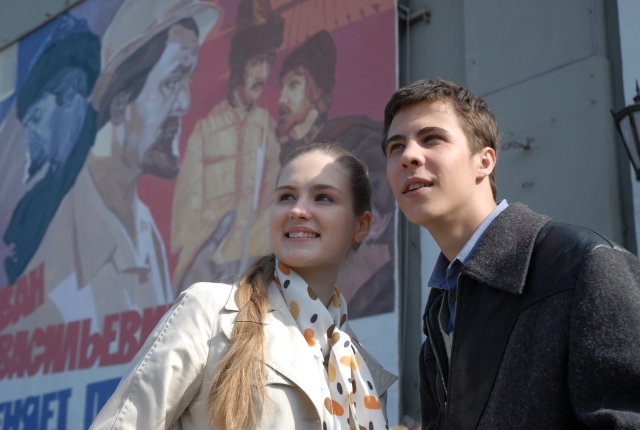
This year’s Russian Resurrection Film Festival is as topical as ever, delivering a showcase of new Russian cinema that is dominated by social and political commentary on the country’s past and present. A highlight includes Karen Shakhnazarov’s most personal film to date, Vanished Empire. Essentially, this film revolves around a dramatic love triangle between three Moscow university students, but the historical period within which these students live shapes much of their character development. Set in the early 1970s, during the peak of Soviet power, Vanished Empire is a nostalgic return to an exciting adolescent past, and to the calm before USSR’s deterioration. This film succinctly captures the challenges that were already influencing everyday life (when Pink Floyd records and label jeans were available only through the dodgy black market), while also weaving in a growing sense of foreboding. It is easily one of the festival’s most watchable offerings, with a touching central storyline and some very relatable characters.

Captive is more explicitly political. From director Alexei Utichel (whose films Dreaming of Space and The Stroll have been featured in past Russian festivals), Captive exposes the folly of the recent Chechen war by portraying meaningless violence, death and destruction from all sides. While some knowledge of the conflict is probably desirable for a more worthwhile viewing experience, it is easy enough to follow the film’s central narrative. A group of Russian soldiers has been isolated in unfamiliar Chechen territory, and two of their number, a responsible commander and an impetuous snipper, have been left with the responsibility of locating a local guide to facilitate their escape. They seize a Chechen boy, but, in the process of drawing him back from the village to their troupe, an interesting rapport develops between the three, with some unexpected consequences. This film makes emotional involvement very difficult, with plenty of dislocated dialogue and long, meandering scenes of silence, so you’ll need to be in the right state of mind. Its conclusion is extremely powerful, though, and its message very important. At just over an hour, Captive presents but a small slice of the tragedy that that has plagued that area in recent time.

The (post-)courtroom drama, 12, also touches upon the Chechen conflict, by exploring its impact upon racial attitudes in contemporary Russia. From director Nikita Mikhalkov (who received an Oscar nomination for Burnt by the Sun), 12 is a distinctly Russian adaptation of Sydney Lumet’s 12 Angry Men. Based around a similar premise, it begins just after courtroom proceedings, as a group of 12 middle-aged male jurors are left alone to reach a unanimous conclusion. Unlike the original, however, where the accused is of African American descent, the accused is now Chechen, and therefore inspires similarly racist sentiments from some of the men. Only one of them is brave enough to speak out in the boy’s defence, but in doing so he provokes the other 11 jurors to think in more depth about the case. As they look further into the intricacies of the accusation, the men also reveal more about themselves and their personal pasts; each of them has in some way been touched by Russia’s tumultuous history. Intriguing up to its finish, 12 ideally captures the pervasive nature of the past. With some fascinating revelations and some solid performances, this film is a real festival highlight.

Tuesday, October 14, 2008

Bitter and Twisted


If anything can be said about the latest Australian drama, Bitter and Twisted, it is that it certainly lives up to its title. Every character unfortunate enough to be caught within this film’s grip is somehow struggling with an unfair fate. The Lombard family saw their eldest son die suddenly and unexpectedly in their very own kitchen. The father (Steve Rogers) has since drawn into himself and become focused on food instead of life, leaving the mother (Noni Hazelhurst) alone and unloved. Meanwhile, their younger son Ben (director Christopher Weekes) battles against infatuation and inadequacy. He’s in love with the girl his brother left behind (Leanna Walsman), while his best friend (Matthew Newton) appears to be falling in love with him.

The actors all put in stellar performances, but somehow these characters remain seemingly inhuman. This is because director/writer Christopher Weeks allows them no human complexity; or, rather, because he does not allow us to see it. Even though this is essentially a film about emotion, we are allowed no glimpse of character’s inner lives. Weekes lingers solely on the exterior manifestations of these emotional states, which makes for a slow-paced and slightly depressing experience, with little reward. Films about hopelessness are rescued from drudgery when they provide some sort of insight into the human condition, or are at least emotionally powerful. Bitter and Twisted, however, remains a struggle, because there is little to be found here beyond a superficial meditation on sadness.

Burn After Reading


Every Coen Brothers film is a guaranteed surprise, and their latest, Burn After Reading, is no exception. Following on from the critically acclaimed thriller, No Country for Old Men, Burn After Reading could hardly be more different. It marks the brothers’ return to the more comedic tones of their earlier offerings, and though it lacks the non-stop humour of The Big Lebowski, there’s certainly enough in there to keep you entertained. The all-star cast includes Coen golden boy George Clooney, alongside Frances McDormand, Brad Pitt, Tilda Swinton and John Malkovich, all of whom rise to the occasion in perfectly portraying clueless eccentricity.

The film weaves a twisted narrative web, connecting these mismatched characters through adultery, blackmail and internet dating. It all kick-starts after the dopey personal trainer Chad (Pitt, in an interesting casting choice) finds a discarded CD containing (what he believes to be) highly confidential CIA information. He and the equally ditzy, plastic-surgery-obsessed Linda (McDormand) trace this disc back to the recently-fired CIA analyst Osbourne Cox (Malakovich). This in turn inadvertently involves them in the love triangle occurring between Cox, his wife Katie (Swinton) and the slimy Treasury agent Harry (Clooney). The plots strains a little under all these complications, but gets through thanks to its sheer, unabashed wackiness. It’s not the sort of film that will leave you laughing for days, but you’ll get at least two hours of fun out of it.

Tuesday, October 7, 2008

Interview with Antonio Zeccola - "Bella Vista"

I catch Antonio Zeccola after his Saturday arvo soccer match. Much hilarity ensues as we discuss that clichéd image of the soccer-ball-toting Italian ex-pat. More seriously, though, the Italian Film Festival director confesses that soccer is his single break from the hard slog of festival organising. “Apart from this three hour break on a Saturday I am thinking about the festival 24/7. It’s always on my mind and there is just so much to do.”

Zeecola’s entire year is based around his pursuit of fine Italian Cinema, with a schedule guaranteed to make any cinephile salivate. “There’s a lot of research that we do, plus I attend the Berlin, Cannes, Venice and Toronto film festivals every year and that’s where I watch all the films and make the selection from what I’ve watched, before I approach the producers and formulate the programme,” he explains. “I’m looking for good films, but also I want to make sure they’re all different; not all about the mafia, or family, or anything like that. I also try to create a story within each festival. It’s like I’m saying ‘this contemporary Italy now,’ or, ‘this is how it was 1945,’ so there’s a message in each programme based on what I choose.”

This year, the festival’s underlying themes include a critique of Italy’s contemporary situation. “If we look just at the opening night film, Her Whole Life Ahead, it is a very sadly contemporary film,” Zeccola asserts. “It’s about a very creative, very smart young girl who passes all her exams with the highest accolades but still can’t get a job. She ends up working in a call centre and is forced to sell things that she is not interested in. This is only one example from the festival, but it connects to the message I’m trying to portray; there are so many qualified people in Italy who don’t have a job. In order to make a living they just have to do whatever they can do.” The director additionally recommends the political opera Il Divo, the period piece Wild Blood and the youthful drama Don’t Think About it. While Zeccola of course quick to add that there is “no bad film in the festival,” he does suggest that these selections will offer any film-goer a condensed summary of the variety on offer.

While it is by no means unusual to hear a festival director describe his current programme as the “best yet,” Zeccola’s words are lent gravity by the current resurgence in Italian cinema. “Since ten years ago, there’s been a resurgence of young directors who have been recounting stories that everyone wants to hear,” Zeccola agrees. “In Italy, up to 30% of audiences watch Italian films which is remarkable because, even in Europe, Hollywood rules. It’s not just happening in Italy, though, it’s also happening in Germany and France. That’s great because it shows that these people have been able to make films that local audiences want to see.

“What’s especially remarkable is that these films that have been very successful have not been blockbusters, they’ve just been made on ordinary budgets of five or six million Euros and they’ve made money back plus just in their own country, let alone elsewhere. Here in Australia we think that you need a lot of money to make great films and attract audiences, but I think Italy shows it’s possible on a lower budget. You just need a good story.”

If Italian audiences are enjoying Italian films, then Zeccola is convinced that others will too. He seems to evoke notion of civic duty when he explains why he feels so passionately about Australia’s international film festivals. “In the film industry, all over the world, we’re so dominated by Hollywood culture, but there is so much more. I guess what we’re trying to do here, through these festivals, is represent other cultures. I was born in Italy so there’s that extra connection in this particular instance, but as you would know, we run French and Israeli and Spanish festivals. In all of these we just seem to have this mission to cultivate and introduce different cultures to the Australian public.”

After eight years of success, he has no doubt that this festival will again draw in the crowds, in Perth and beyond. “When we started in 2000, our festival barely had half a dozen films and of course the number that people came was very small. Nonetheless, we were encouraged, because Italy continued to produce some amazing films and these films wouldn’t have be seen by Australians, be they of Italian origin or just cinephiles or ‘Italiaphiles,’ unless this festival was around. And the festival has continued to grow each year. This year, over in Melbourne and Sydney, we’ve already seen attendance increase by about 20 or 30 percent, which is remarkable.”

A fine turn-out inevitably eases the hard work involved in reaching that point, and Zeccola adamantly agrees. “I’ve been doing this for so many years now, and there’s still a personal satisfaction in walking into an auditorium and seeing it full. I especially love trying to gauge the audience, and tell whether they’re laughing, or whether you can hear a pin drop, or whether they’re restless. And I really love that part of it. I think it’s in my blood, I’ve been doing it for decade and I still love it, and I’m sure I’m going to love it for as long as I do it.”

Sunday, October 5, 2008

Towelhead


Screenwriter Alan Ball has always been fascinated by damaged people; he brought us the mid-life crisis of Lester Burnham in American Beauty, and the twisted, uncommunicating Fisher family of Six Feet Under. Now, his attention has turned to a thirteen-year-old Arab-American girl named Jasira (Summer Bishil) with his second film script and feature length directorial debut, Towelhead. Adapted from Alicia Erian's novel, Nothing is Private, the film is a no-holes-barred exploration of the young Jasira’s sexual awakening. From its very first scene, in which we see an older man helping the pre-pubescent Jasira shave away her bikini area, this film makes clear its intentions, and it certainly follows through. This scene will be followed by many more like it, as Jasira encounters a plethora of sexual experiences over a very short period of time.
Call me naïve, but Jasira’s age feels ridiculous in the film. Not because thirteen-year-olds aren’t having sex, but because they certainly don’t acquire a mature, adult perspective on these issues over the course of one semester. So much of Jasira’s dialogue feels premature and unrealistic, and the adult characters mirror this same lack of credibility, but reverse it. They become caricatures in their universal impotence, seeming excessively immature and irresponsible. Additionally, it’s hard to handle the sheer myriad of issues that Ball has inserted into this film; psychological, sexual, political, social, the list goes on! They’re so clumsily wound together, and without any moment of relief (comic or otherwise). In the end, the film is appealing in that classic ‘car crash’ manner. It’s difficult to tear your eyes away from its relentless explicitness and its ever twisting plotline, yet the pleasure is perverse. It will no doubt leave you feeling viscerally affected, but you’ll probably be forced to question whether you really took anything else away from the experience.

Sunday, September 7, 2008

Funny Games

Austrian director Michael Haneke (Hidden) claims that his latest film, Funny Games (a shot-by-shot remake of his own 1997 German-language film) is a commentary on violence and the media, and on the way in which “American cinema toys with human beings… [and] makes violence consumable.” He argues that, through to-camera asides and “emotional episodes” he successfully subverts the genre, and makes the audience complicit in these characters’ violence. According to Haneke, if you see this film through to its conclusion, you’re actually jumping aboard America’s cinematic violence train and tooting its horn. And herein lies the messy contradiction; Haneke is adhering to the very mentality that he so vehemently critiques. Additionally, he hasn’t quite succeeding in obtaining that level of subversion that is necessary to make audiences aware of his message. Funny Games therefore ironically ends up as just another mad thriller, not unlike so many others produced in America.

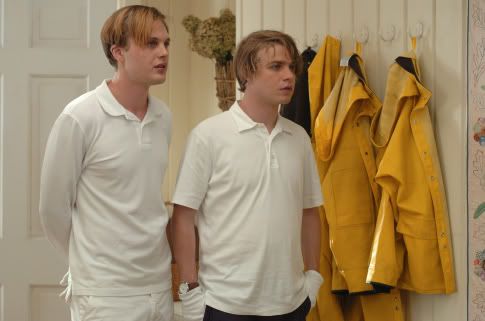
The film follows the affluent (and very white) Faber family as they arrive at an idyllic riverside holiday home. Annie (Naomi Watts), George (Tim Roth) and their young son Georgie (Devon Gearhart) begin their holiday in high spirits but soon find themselves unnerved by two overly polite yet unnervingly creepy boys who come over from next door, apparently in search of eggs. Dressed in white costumes that seem to eerily recall something of A Clockwork Orange, Paul (Michael Pitt) and Peter (Brady Corbett) make their intentions known soon enough; they find pleasure in psychological torture and gradually pump up the terror levels. Haneke doesn’t show any graphic violence on-screen, but this somehow feels all the more terrifying. Paul occasionally speaks to the camera, and these moments must be those ‘asides’ that Haneke believes subvert the thriller genre, but they’re not nearly great enough in number or effect to achieve anything significant. In the end, Haneke can intellectualise this terror as much as he wants, but that won’t change the fact that this thriller is ugly, terrifying and just as much entwined in the American cinematic apparatus as the next one. And where does that leave Haneke's philosophy?