Tuesday, December 9, 2008

Interview with Sherry Hopkins


This year’s Lotterywest Film Festival feels a little different. For starters, it’s much longer than usual. Spanning five months and featuring 21 feature films from all around the world, this season is the longest yet. More pertinently though, you’ll note that, for the first time in many years, French comedy darling Daniel Auteil is no where to be found. It’s almost incomprehensible.

While the Festival still features a healthy dash of light-hearted comedy, this year’s programme is characterised by its more serious, and more topical entries. “This is a very discerning and intelligent audience, and they want something meaty that they can talk about afterwards,” explains the programme’s director, Sherry Hopkins.

“They want current affairs, and what’s going on around them,” she continues. “As much as they like the occasional little light comedies, and they will like Pain in the Ass, the new Francis Veber comedy, because Perth audiences love Francis Veber [of The Dinner Game] – but as much as they like that, they’re also showing me that they appreciate these more grand scale films too.”

This year, audiences can expect to be shocked by Buddha Collapsed out of Shame, as it exposes the permeating influence of the Taliban through a group of Afghani schoolchildren determined to mimic their parents. They can expect to be baffled by the ridiculous true story at the core of Lemon Tree, in which a Pakistani widow travels to the High Court to protect her lemon grove from Israel’s paranoid Defence Minister. They can expect to be shaken by the Oscar-nominated Katyn, Andrzej Wajda’s powerful drama about the infamous Soviet massacre. All of these films, and many others, are guaranteed to linger with audience members, and to fuel plenty of post-film discussion.

Furthermore, while the Festival Films have always served as portals across the globe, Hopkins argues that this year their reach is also far wider than ever before. “It’s much more of a global picture than usual; I think we’re transporting people more this year. We’ve got two Israeli films, for example, and one Iranian film, Lemon Tree, which is a fine film.”

Despite this evolution, though, the Festival season begins as always, with a couple of lighter films set in familiar, Western contexts. “My hardest job is finding the opening films,” Hopkins confesses, “We try to open with an English language film if we can. We want something to ease people into the program, sometimes perhaps a French comedy. One year we had nothing so I put in Affliction, which was great and won all those awards, but was just too heavy.”
Last week, Sommerville lit up with Young@Heart, a heart-warming piece that sees pensioners reinvigorated by a turn towards punk, disco and rock music. Meanwhile at Joondalup Pines, the British comedy, Grow Your Own, which charts the relationship between a group of “grumpy old men” and the family of asylum seekers that take over a nearby garden patch, has apparently received rave reviews from Joondalup’s large English community. The two films swap locations for the coming week.

For those still uncertain, Hopkins has a couple of recommendations. “I’ve Loved You So Long is the best film in the Festival. Also, apart from the storyline, I think that the style of animation for Waltz with Bashir is amazing, that’s why it’s winning all these awards. You the Living also, is bizarre yet terrific. Every scene is like a picture postcard, and there’s this one scene where a couple get married on a house on train which is just mesmerising.”

In amongst these global stories, Hopkins also disperses a series of West Australian shorts. “I just don’t want to throw in any short with any feature,” she warns, “they’ve got to work together; usually it’s in terms of fitting the subject matter together.” Hopkins also hopes to one day premier a W.A. feature film, but in the meantime one aspect of the festival remains unchanged; its commitment to delivering fascinating stories from all across the globe to the most isolated city within it.

Wednesday, November 19, 2008

Youth without Youth


If there is any conclusion to be drawn from Francis Ford Coppola’s Youth without Youth, it is that the acclaimed director has obviously lost the plot. It’s been a decade since his last helming effort (The Rainmaker), but now Coppola returns with a film that is more likely to remind audiences of recent David Lynch than of anything from Coppola’s filmmaking past. The premise is that Dominic, an aging Romanian linguist (Tim Roth), is hit by a strike of lightning in 1938, and consequently returned to physical youthfulness. Nazi scientists are intrigued by this rejuvenation and so plant a spy in his hotel, but in the meantime the lightning also appears to have produced an evil alter ego that Dominic can converse with through mirrors. In amongst this all, Dominic struggles to complete his great linguistic work, while encountering a love from his past who is also wrestling with her own problems; a past life as an Indian woman that continually resurfaces through violent trances.

This basic description might hint at some deeper connections or explanations, but these are never forthcoming. The plot simply moves into increasingly unexpected and incongruous twists or tangents without ever reaching any emotional or intellectual heights. Excessively verbose dialogue only serves to confuse rather than clarify, in a classic display of empty pretentiousness. Tim Roth puts in a fine effort, but clearly struggles to develop an appealing or interesting character from this lacklustre script. What’s more, although this film marks Coppola’s return to the low-budget filmmaking form he used to so revere, the director seems to misuse the accompanying artistic freedom for the sake of it. The already-complicated storyline is only further cluttered by with unnecessary upside-down shots, extreme close-ups, jolted pans and surreal visual devices. The simplistic set design (with Romanian landscapes standing in for Switzerland, Malta and India) is disappointingly at odds with the madcap storyline. Essentially, Coppola has produced an extremely self-conscious, stilted and uninspiring work that will let down fans and newcomers alike.


Monday, November 10, 2008

Russian Resurrection Film Festival Reviews


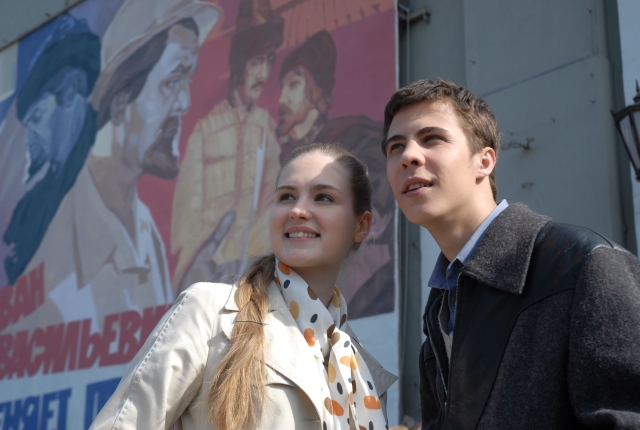
This year’s Russian Resurrection Film Festival is as topical as ever, delivering a showcase of new Russian cinema that is dominated by social and political commentary on the country’s past and present. A highlight includes Karen Shakhnazarov’s most personal film to date, Vanished Empire. Essentially, this film revolves around a dramatic love triangle between three Moscow university students, but the historical period within which these students live shapes much of their character development. Set in the early 1970s, during the peak of Soviet power, Vanished Empire is a nostalgic return to an exciting adolescent past, and to the calm before USSR’s deterioration. This film succinctly captures the challenges that were already influencing everyday life (when Pink Floyd records and label jeans were available only through the dodgy black market), while also weaving in a growing sense of foreboding. It is easily one of the festival’s most watchable offerings, with a touching central storyline and some very relatable characters.

Captive is more explicitly political. From director Alexei Utichel (whose films Dreaming of Space and The Stroll have been featured in past Russian festivals), Captive exposes the folly of the recent Chechen war by portraying meaningless violence, death and destruction from all sides. While some knowledge of the conflict is probably desirable for a more worthwhile viewing experience, it is easy enough to follow the film’s central narrative. A group of Russian soldiers has been isolated in unfamiliar Chechen territory, and two of their number, a responsible commander and an impetuous snipper, have been left with the responsibility of locating a local guide to facilitate their escape. They seize a Chechen boy, but, in the process of drawing him back from the village to their troupe, an interesting rapport develops between the three, with some unexpected consequences. This film makes emotional involvement very difficult, with plenty of dislocated dialogue and long, meandering scenes of silence, so you’ll need to be in the right state of mind. Its conclusion is extremely powerful, though, and its message very important. At just over an hour, Captive presents but a small slice of the tragedy that that has plagued that area in recent time.

The (post-)courtroom drama, 12, also touches upon the Chechen conflict, by exploring its impact upon racial attitudes in contemporary Russia. From director Nikita Mikhalkov (who received an Oscar nomination for Burnt by the Sun), 12 is a distinctly Russian adaptation of Sydney Lumet’s 12 Angry Men. Based around a similar premise, it begins just after courtroom proceedings, as a group of 12 middle-aged male jurors are left alone to reach a unanimous conclusion. Unlike the original, however, where the accused is of African American descent, the accused is now Chechen, and therefore inspires similarly racist sentiments from some of the men. Only one of them is brave enough to speak out in the boy’s defence, but in doing so he provokes the other 11 jurors to think in more depth about the case. As they look further into the intricacies of the accusation, the men also reveal more about themselves and their personal pasts; each of them has in some way been touched by Russia’s tumultuous history. Intriguing up to its finish, 12 ideally captures the pervasive nature of the past. With some fascinating revelations and some solid performances, this film is a real festival highlight.

Tuesday, October 14, 2008

Bitter and Twisted


If anything can be said about the latest Australian drama, Bitter and Twisted, it is that it certainly lives up to its title. Every character unfortunate enough to be caught within this film’s grip is somehow struggling with an unfair fate. The Lombard family saw their eldest son die suddenly and unexpectedly in their very own kitchen. The father (Steve Rogers) has since drawn into himself and become focused on food instead of life, leaving the mother (Noni Hazelhurst) alone and unloved. Meanwhile, their younger son Ben (director Christopher Weekes) battles against infatuation and inadequacy. He’s in love with the girl his brother left behind (Leanna Walsman), while his best friend (Matthew Newton) appears to be falling in love with him.

The actors all put in stellar performances, but somehow these characters remain seemingly inhuman. This is because director/writer Christopher Weeks allows them no human complexity; or, rather, because he does not allow us to see it. Even though this is essentially a film about emotion, we are allowed no glimpse of character’s inner lives. Weekes lingers solely on the exterior manifestations of these emotional states, which makes for a slow-paced and slightly depressing experience, with little reward. Films about hopelessness are rescued from drudgery when they provide some sort of insight into the human condition, or are at least emotionally powerful. Bitter and Twisted, however, remains a struggle, because there is little to be found here beyond a superficial meditation on sadness.

Burn After Reading


Every Coen Brothers film is a guaranteed surprise, and their latest, Burn After Reading, is no exception. Following on from the critically acclaimed thriller, No Country for Old Men, Burn After Reading could hardly be more different. It marks the brothers’ return to the more comedic tones of their earlier offerings, and though it lacks the non-stop humour of The Big Lebowski, there’s certainly enough in there to keep you entertained. The all-star cast includes Coen golden boy George Clooney, alongside Frances McDormand, Brad Pitt, Tilda Swinton and John Malkovich, all of whom rise to the occasion in perfectly portraying clueless eccentricity.

The film weaves a twisted narrative web, connecting these mismatched characters through adultery, blackmail and internet dating. It all kick-starts after the dopey personal trainer Chad (Pitt, in an interesting casting choice) finds a discarded CD containing (what he believes to be) highly confidential CIA information. He and the equally ditzy, plastic-surgery-obsessed Linda (McDormand) trace this disc back to the recently-fired CIA analyst Osbourne Cox (Malakovich). This in turn inadvertently involves them in the love triangle occurring between Cox, his wife Katie (Swinton) and the slimy Treasury agent Harry (Clooney). The plots strains a little under all these complications, but gets through thanks to its sheer, unabashed wackiness. It’s not the sort of film that will leave you laughing for days, but you’ll get at least two hours of fun out of it.

Tuesday, October 7, 2008

Interview with Antonio Zeccola - "Bella Vista"

I catch Antonio Zeccola after his Saturday arvo soccer match. Much hilarity ensues as we discuss that clichéd image of the soccer-ball-toting Italian ex-pat. More seriously, though, the Italian Film Festival director confesses that soccer is his single break from the hard slog of festival organising. “Apart from this three hour break on a Saturday I am thinking about the festival 24/7. It’s always on my mind and there is just so much to do.”

Zeecola’s entire year is based around his pursuit of fine Italian Cinema, with a schedule guaranteed to make any cinephile salivate. “There’s a lot of research that we do, plus I attend the Berlin, Cannes, Venice and Toronto film festivals every year and that’s where I watch all the films and make the selection from what I’ve watched, before I approach the producers and formulate the programme,” he explains. “I’m looking for good films, but also I want to make sure they’re all different; not all about the mafia, or family, or anything like that. I also try to create a story within each festival. It’s like I’m saying ‘this contemporary Italy now,’ or, ‘this is how it was 1945,’ so there’s a message in each programme based on what I choose.”

This year, the festival’s underlying themes include a critique of Italy’s contemporary situation. “If we look just at the opening night film, Her Whole Life Ahead, it is a very sadly contemporary film,” Zeccola asserts. “It’s about a very creative, very smart young girl who passes all her exams with the highest accolades but still can’t get a job. She ends up working in a call centre and is forced to sell things that she is not interested in. This is only one example from the festival, but it connects to the message I’m trying to portray; there are so many qualified people in Italy who don’t have a job. In order to make a living they just have to do whatever they can do.” The director additionally recommends the political opera Il Divo, the period piece Wild Blood and the youthful drama Don’t Think About it. While Zeccola of course quick to add that there is “no bad film in the festival,” he does suggest that these selections will offer any film-goer a condensed summary of the variety on offer.

While it is by no means unusual to hear a festival director describe his current programme as the “best yet,” Zeccola’s words are lent gravity by the current resurgence in Italian cinema. “Since ten years ago, there’s been a resurgence of young directors who have been recounting stories that everyone wants to hear,” Zeccola agrees. “In Italy, up to 30% of audiences watch Italian films which is remarkable because, even in Europe, Hollywood rules. It’s not just happening in Italy, though, it’s also happening in Germany and France. That’s great because it shows that these people have been able to make films that local audiences want to see.

“What’s especially remarkable is that these films that have been very successful have not been blockbusters, they’ve just been made on ordinary budgets of five or six million Euros and they’ve made money back plus just in their own country, let alone elsewhere. Here in Australia we think that you need a lot of money to make great films and attract audiences, but I think Italy shows it’s possible on a lower budget. You just need a good story.”

If Italian audiences are enjoying Italian films, then Zeccola is convinced that others will too. He seems to evoke notion of civic duty when he explains why he feels so passionately about Australia’s international film festivals. “In the film industry, all over the world, we’re so dominated by Hollywood culture, but there is so much more. I guess what we’re trying to do here, through these festivals, is represent other cultures. I was born in Italy so there’s that extra connection in this particular instance, but as you would know, we run French and Israeli and Spanish festivals. In all of these we just seem to have this mission to cultivate and introduce different cultures to the Australian public.”

After eight years of success, he has no doubt that this festival will again draw in the crowds, in Perth and beyond. “When we started in 2000, our festival barely had half a dozen films and of course the number that people came was very small. Nonetheless, we were encouraged, because Italy continued to produce some amazing films and these films wouldn’t have be seen by Australians, be they of Italian origin or just cinephiles or ‘Italiaphiles,’ unless this festival was around. And the festival has continued to grow each year. This year, over in Melbourne and Sydney, we’ve already seen attendance increase by about 20 or 30 percent, which is remarkable.”

A fine turn-out inevitably eases the hard work involved in reaching that point, and Zeccola adamantly agrees. “I’ve been doing this for so many years now, and there’s still a personal satisfaction in walking into an auditorium and seeing it full. I especially love trying to gauge the audience, and tell whether they’re laughing, or whether you can hear a pin drop, or whether they’re restless. And I really love that part of it. I think it’s in my blood, I’ve been doing it for decade and I still love it, and I’m sure I’m going to love it for as long as I do it.”

Sunday, October 5, 2008

Towelhead


Screenwriter Alan Ball has always been fascinated by damaged people; he brought us the mid-life crisis of Lester Burnham in American Beauty, and the twisted, uncommunicating Fisher family of Six Feet Under. Now, his attention has turned to a thirteen-year-old Arab-American girl named Jasira (Summer Bishil) with his second film script and feature length directorial debut, Towelhead. Adapted from Alicia Erian's novel, Nothing is Private, the film is a no-holes-barred exploration of the young Jasira’s sexual awakening. From its very first scene, in which we see an older man helping the pre-pubescent Jasira shave away her bikini area, this film makes clear its intentions, and it certainly follows through. This scene will be followed by many more like it, as Jasira encounters a plethora of sexual experiences over a very short period of time.
Call me naïve, but Jasira’s age feels ridiculous in the film. Not because thirteen-year-olds aren’t having sex, but because they certainly don’t acquire a mature, adult perspective on these issues over the course of one semester. So much of Jasira’s dialogue feels premature and unrealistic, and the adult characters mirror this same lack of credibility, but reverse it. They become caricatures in their universal impotence, seeming excessively immature and irresponsible. Additionally, it’s hard to handle the sheer myriad of issues that Ball has inserted into this film; psychological, sexual, political, social, the list goes on! They’re so clumsily wound together, and without any moment of relief (comic or otherwise). In the end, the film is appealing in that classic ‘car crash’ manner. It’s difficult to tear your eyes away from its relentless explicitness and its ever twisting plotline, yet the pleasure is perverse. It will no doubt leave you feeling viscerally affected, but you’ll probably be forced to question whether you really took anything else away from the experience.