Sunday, September 30, 2007

Away From Her

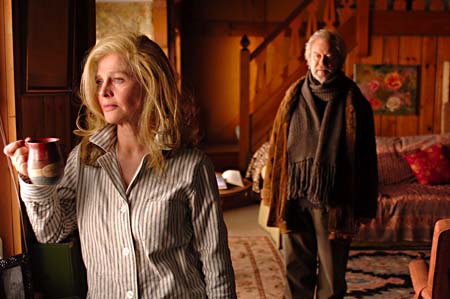
Sarah Polley seems an unlikely candidate for the direction of a film about old age. Having began her film career as a child television actor, the sprightly 28 year-old Canadian has spent the rest of it skipping through various acting instalments – most notably her touching portrayal of a mother dying from cancer in My Life Without Me. Stepping behind the camera for the first time, Polley tackles surprisingly similar themes in Away From Her, but this time her focus has skipped backwards a generation. The main characters are in their sixties, and this time Alzheimer’s is the destructive force slowly erasing its victim. After a 44-year marriage, Grant (Gordon Pinsent) has to cope with the gradual mental dissent and institutionalisation of his suffering wife, the eccentric and beautiful Fiona (Julie Christie).

Based upon the short story “The Bear Came Over the Mountain,” Away From Her sounds simplistic when described on paper – and to a certain extent this initial judgement remains correct. Yet, though the drama may remain relatively straight forward, Polley effectively steers it away from all expected clichés and potentially maudlin developments through a series of subversive narrative turns. What’s more, this uncluttered narrative has obviously allowed Polley room to move. She has unearthed a rich complexity from the space between the lines, inscribing a multi-layered complexity upon every pause in the script.

And, in the end, the strength of Away From Her lies not in its thought-provoking dialogue or in its richly crafted characters, but in its visual impact. In the way that Christie’s face flickers elusively between recognition and confusion. In the soft edged pastels of Grant’s flashbacks, toned with nostalgia and regret. In the heart wrenching devotion with which he observes his wife from afar. And in the palpable distance that slowly wedges itself between them, like an invisible current subtly pulling them apart. These are the images that will remain with you days after seeing the film, infused with a seemingly unaltered emotional impact. This is a rare gem of a film, but please remember to bring tissues with you. Trust me.

Rating: 9.4

Monday, September 17, 2007

Superbad


It’s hard not to be jealous of teenagers today. While we had clunky discmans and thick CD wallets, they have svelte iPods. While we were stuck with demure, wholesome Christina Aguilera, they enjoy racy Xtina. And while our age-defining comedy ‘classic’ was the painful American Pie, they are able to enjoy the genuine humour of Seth Rogen and Evan Goldberg (part of the crew responsible for The 40 Year Old Virgin and Knocked Up). Superbad is everything a teenage comedy should be – it is immature without being simplistic, and it is offensive without being cringe-worthy. Rogen and Goldberg have obviously drawn upon their own high school experiences in carving the central characters, Seth (Jonah Hill) and Evan (Michael Cera, playing a somewhat more racy version of Geroge Michael from Arrested Development). Unpopular and generally disliked, Seth and Evan unexpectedly gain entrance into a ‘cool’ party when their nerdy friend Fogell (Christopher Mintz-Plasse) scores a fake ID. What begins a simple attempt to purchase alcohol, though, quickly descends into a night of unpredictable madness, involving jaded policemen, unexpected sexual encounters and dangerous gatecrashing. In a genre that suffers from its lack of originality, Superbad is a breath of fresh air, injecting a unique freshness into the well-worn teen themes of virginity, romance, alcohol, friendship and moving away. If you’re willing to suffer through a seemingly endless series of penis jokes (and one really terrible menstruation gag) then this movie will deliver genuine laughs, and also an unexpectedly touching sentiment.

Rating: 8.9

Strummer: The Future is Unwritten


When Joe Strummer (the legendary front man of The Clash) passed away in 2002, his best friend, filmmaker and musician Julien Temple (of The Filth and the Fury), decided to immortalise Strummer’s life on celluloid with Strummer: The Future is Unwritten. If you’re looking for a film that exemplifies exactly how not to make a music documentary, then look no further. This is a perfect case in point. While it’s easy to understand why, it’s nonetheless disappointing that this film feels more like a eulogy than a documentary. Temple has gathered Strummer’s friends and associates around a campfire (a perplexing stylistic choice not explained before the film’s conclusion) and together they reminisce. These scattered reflections are largely sycophantic, and Temple clearly makes little attempt to paint a holistic portrait. Furthermore, for no apparent reason, none of the interviewees are identified, and so the patchwork of memories that they weave together feels more like a labyrinthine maze, made all the more confusing by the inclusion of token celebrities (Steve Buscemi, Johnny Depp, and, of course, Bono). This movie is long, repetitive, puzzling, self-indulgent and unyieldingly boring, which is a pity, because with some very simple clarifications, it could almost have been saved.

Rating: 3.8

The Bet


“A broker. A banker. A bet.”

This tagline essentially summarises everything you need to know about the latest, privately financed, film from director Mark Lee (Gallipolli). You won’t gleam much more from actually watching it. Matthew Newton (Looking for Allibrandi, and, more famously, Bert Newton’s Son) is the boyish-faced stockbroker from a working class background, Aden Young (Black Robe) his the cocky, affluent banker friend, and their bet is a 90 day race to see who can be the first to earn $100 000. And, yes, it’s refreshing that while most Australian films relish our country’s lost youths and our suburban misery, this one should jump into our upper class, where the characters play golf, buy diamonds and know exactly what they want out of life. It’s very possible that this film could have been intriguing insight into Australia’s fast paced stock market world, or a riveting financial thriller to rival Boiler Room, or its closest Australian counterpart, The Bank. Unfortunately, though, this film suffers from an irrational intensity, compounded by its percussive soundtrack, weighted dialogue and unnecessarily prologued close-ups. Additionally, while Neweton’s broker does occasionally elicit flickers of empathy, the other character characters (in particular Young’s banker, Angus) are infuriatingly shallow. These characters are one-dimensional ciphers, existing merely to propel the heavy-handed narrative.


Rating: 4.2

Monday, September 10, 2007

Russian Film Festival Reviews


This week, for the first time in Perth, Cinema Paradiso will host the Russian Film Festival, Russian Resurrection. One film enjoying its world-wide premier as part of this festival is Vitali Melnikov’s Beat the Enemy. Set in the waning months of the Second World War, this film charts a communist propaganda group, hastily assembled from mismatched exiles and actors, as it travels down a remote Siberian river. Stopping at various isolated communities, the group’s task is to glorify Soviet military feats through an eclectic fusion of song, dance, music, theatre, art and silent film. What begins as a seemingly simplistic narrative quickly develops into a rich tapestry of wildly variable encounters and gradually shifting relationships, that all come to a head when the team’s vessel floods, and they find themselves isolated on one of the river’s sparsely populated islands.

Whether they be propaganda projects or powerful post-war reflections, Russia has always been renowned for its war films, and for its treatment of wartime themes. While not set on the frontline, Beat the Enemy is a powerful and appropriately complex exploration of the war’s impact in Russia, and of this tremulous transition period in Russian history. By introducing so many varied local communities, the films scans the whole register of emotional responses – from the devoted Communist youth leader who barks orders at her inferiors and cries over the propaganda footage, to the old woman forced to saw the crucifix off her local chapel as it becomes a Communist ‘activities’ hall,’ to the German exiles suspended in limbo between two identities. But what truly rescues this film from mediocrity is the complex development of its five main characters. These characters shift unpredictably as the narrative progressions, and, even though this results in a far less concise narrative, their rapid mood swings are indulged and given full reign. The result is a film that is touchingly realistic, and thought-provoking in its density. Produced in grey tones and adhering to all classic conventions, this is no cinematic marvel, but it is an intriguing character study, tinted with an emotional variety that marks it as uniquely Russian.

Far less successful is Heat, Russia’s miserable attempt at romantic comedy. Set in the midst of a stifling Russian heat wave, this film sees four school friends reunite several years after graduation. These men are clearly meant to symbolise a cross-section of Russian society, with the navy boy, spoilt rich kid, aspiring actor and black ‘gansta’ all represented. This mix of characters feels painfully contrived, and the narrative developments seem to only emphasise this self-consciousness. This feels like a film that is desperately trying to represent modern Moscow as a space that is “Western-yet-still-distinctly-Russian,” but its desperation to do so results in it failing miserably, both as a tourism advertisement and as a film.

The narrative itself is wildly ridiculous, and not even in a pleasingly post-modern or seductively surrealist manner. It’s just plain silly. Somehow, all the characters end up going their separate ways and finding themselves on madcap, screwball adventures that transport them alternately through prison cells, nightclubs, penthouses, film sets, construction sites, mafia meetings and underpasses guarded by violent street gangs, where they alternately encounter romance, career development, violence and party. To make matters worse, this narrative is portrayed in the clumsiest, messiest manner imaginable. The varying sub-plots are confusingly interwoven so that it’s difficult to tell what is what and who is who, reducing the film to a convoluted mass of unbelievable city encounters. It’s impossible to make sense of this chaotic offering, and one hopes that this film reached number one at the Russian Box Office only because the same people saw it repeatedly, in the hope of uncovering some semblance of meaning.

Beat the Enemy: 6.5
Heat: 2.0

Sunday, September 9, 2007

Interview with Nicholas Maksymow


No film student worth their salt could deny Russia’s epic influence upon cinema history. It was here that montage techniques were first pioneered and refined, and it was here that some of film history’s greatest masterpieces were born. So many years and one iron curtain later, and Russia is again eager to reassert its position on the international cinema landscape. The 2007 Russian Film Festival Russian Revolution is a tribute to Russia’s fast growing cinema industry, and, this week, it makes its way into our part of the globe.

“Russia’s film production is increasing at an incredible rate!” exclaims the festival director, Nicholas Maksymow, “Firstly, there are lots of private bodies who provide funding for budding filmmakers, and if that does not work there is always the state funding board. What’s happening there now is similar to what the AFI did in the late seventies to revive the Australian film industry. There’s this strong, creative reenergising.”

Luckily, Russian filmmakers are also enjoying a lucrative success at the Russian box office. This year they are expected to retain over one quarter of the total national box office takings. “Unlike Australians, Russians don’t really experience that kind of ‘cultural cringe’,” explains Maksymow. “There really isn’t a pressure to be Western, because Russians are so proud of all their art and above all their cinema… Films like Daywatch and Nighwatch and Wolfhound are obviously Russian films trying to copy Hollywood, but there is still this unique ‘Russianness’ about them, and there’s no pressure to get rid of that. In fact, that’s why people seem to enjoy them so much.”

Maksymow connects this sense of “Russianness” with the Russian artistic drive to paint realistically complex pictures of daily life, that accurately scan the whole range of the emotional spectrum. “For instance, in one movie you might cry, you might laugh and you might feel scared,” he emphasises, “There is so much emotion going through one film and that’s what life is like in Russia at the moment, because it’s so unpredictable. In everyday life people go through both laughter and hardship, and Russian film is all about capturing that realistically.” At this point, he laughs about how the highest rating Australian film to have ever been screened in Russia was Lantana – a fact that he attributes to Lantana’s complex, realistic, and unquestionably dark, treatment of human emotions.

If there is one section of human life, though, from which Russian cinema steers clear, it is contemporary Russian politics. While the world reels in response to news about Russia’s (often brutal) censorship of political journalism, the film industry is safe in its detachment. Maksymow explains, “The journalists get into trouble because they’re overtly political, and trying to push a certain view, while cinema is still seen as a democratic form of the arts, in the sense that it’s not really political at all. Filmmaking doesn’t really touch sensitive political issues in Russia; it’s more about making fun of the old politicians and examining our past than looking at the contemporary situation.”

Cinema and politics therefore enjoy mutual support and respect in Russia, a phenomenon reflected by the fact that Vladimir Putin (the Russian first head of state to ever visit Australia) officially opened the festival in Sydney last week. Significantly, Putin’s visit to Australia (for the APEC summit) corresponds with the 200 year anniversary of Australia’s relationship with Russia. Maksymow ponders on how all these aspects work together to strengthen international cultural understandings, as he reflects, “While obviously our relations, and Putin’s visit, have been mainly political and economic… festivals like these fill in the cultural aspects… I believe that what we’re trying to do by having Russian film festivals in Australia is giving not only those of Russian heritage, but also Australian citizens, a chance to see something they would not usually see.”

Interview with Anna Broinowski


Out of the often overwhelming mass of documentary genre clones and failed attempts at objectivity, there rises one, recent, unique offering. From director Anna Broinowski, Forbidden Lie$ explores the controversy surrounding Norma Khouri, the international best-selling author of an autobiographical novel about Jordanian honour killings, who was later exposed as a fraud and a con-artist. Rather than simply forcing one perspective or opinion upon her audiences, Broinowski plays with the notion of truth, spin and fact, encouraging viewers to question the film they are watching as much as they question Khouri herself.

“I think that people who say that documentary filmmaking is the most truthful form of filmmaking are not correct,” Broinowski asserts, “I think that the minute you point your camera at someone, whether it’s a drama or a doco, you are shaping reality… Every decision is personal, and it’s all about your opinion of the subject. I was keen to explore that in the film, and Norma’s tendency to deceive people became the perfect springboard for me to mirror stylistically what she does to people’s minds.” Drawing more inspiration from con movies like Catch Me If You Can and Ocean’s 11 than from the well worn conventions of documentary filmmaking, Forbidden Lie$ is peppered with CGI, fast paced cinematography, snappy cutaways and dramatic re-enactments.

The dramatic impact of the film is certainly enhanced by the fact that all Broinowski’s interview subjects presented such animated testimonies that they feel almost staged. “None of them were scripted, and I too was gob smacked,” she remembers, “I just couldn’t believe my luck when this high-up lawyer in Chicago said to me, point blank, to the camera, having just met me, ‘She is evil and diabolical.’ I think it wasn’t so much good fortune, but the fact that Norma polarises people around her, so you can’t have a mediocre response to her. So it was delightful, because everyone was passionate about her, whether for or against. And I was like a kid in a toy store, because I had this cast like something from a thriller, and the only difference was that they were real.”


Like many of the people she interviewed, including sophisticated minds in media, publishing and law, Broinowski was also not immune to the charm of this sweet talking woman. She describes herself as initially being a “Norma convert,” and remembers how her initial vision for the film was one that would redeem Khouri, and prove the media’s negative spin on her to be entirely incorrect. “Norma is so likeable you really want to believe that she’s no where near as cunning or as diabolical as these crimes that she’s done would make her out to be,” Broinowski stresses, “She’s really audacious, she’s feisty, and she has a strong spirit. In many ways she’s a post-feminist icon… and you can’t help but admire that. And how do you marry that up with the fact that she tricked an old woman out of her life savings and her home?”

Naturally, this vision had to shift, as promised evidence and interview subjects disappeared, and Khouri’s story became more and more tangled. Broinwoski insists though, that this film shouldn’t be about judging Khouri, so much as about judging the system in which we live, that allows people like her to thrive. “The film’s message is ‘trust no one, believe no one, question everything, corroborate everything’,” she concludes. “I think that we have lost contact with the importance of truth. As a society, we have become so cynical that we know longer care about the fact that we’re being spun to by the media and by politicians. We need to fight again, to make truth and facts and investigation important once more.”